
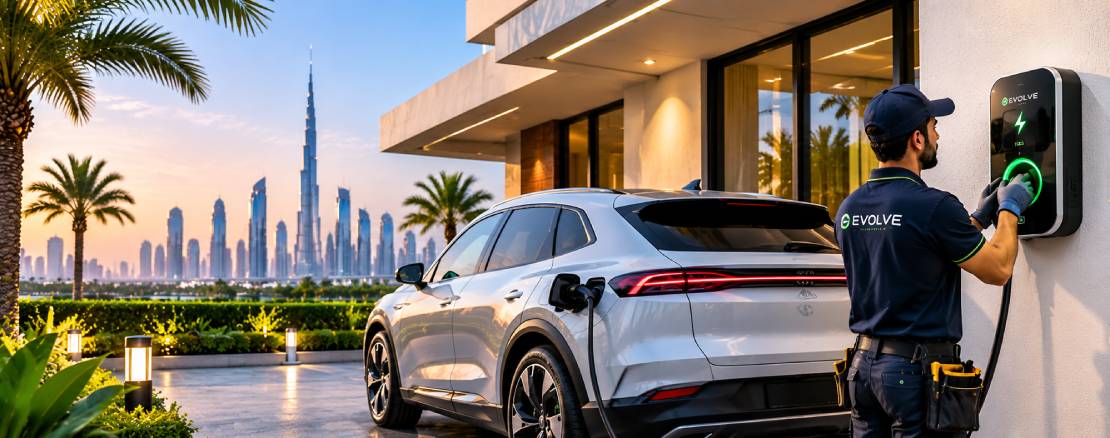

Most new EV owners in Dubai plan to charge at home. Far fewer know what actually happens between booking an installer and plugging in for the first time.
That gap is where most delays come from. A board with no spare capacity, a community that wants paperwork first, or a charger that’s faster than your car can use can all push your start date back.
This guide walks through home EV charger installation Dubai homeowners go through with Evolve, one stage at a time. You’ll see what each step involves, why it’s there, and what you can do to keep things on track.
Before You Book: What Evolve Needs to Know
Three details shape almost every decision that follows. Having them ready when you call makes the EV charger site survey quicker and keeps the EV charger installation process in Dubai on schedule.
Your car
Your car’s onboard charger decides the top AC charging speed. Plug a car that accepts 7 kW into a 22 kW unit, and it still charges at 7 kW. Most EVs sold in the UAE accept 7 kW or 11 kW on AC, and only a handful take the full 22 kW. Plug-in hybrids often accept less.
Check the AC charging rating in your owner’s manual, or look up your model in our charger sizing guide for BYD, Jetour, Geely and other popular EVs.
Your parking spot
Let the team know whether you park in a closed garage, a covered carport or an open driveway. A garage protects the unit from sun, sand and rain. Outdoor spots work well too, as long as the charger is rated for outdoor use and placed with some thought.
Your DB location
The DB (distribution board) is the panel of breakers that feeds your home. The distance between it and your parking spot decides how much cable the job needs, and cable is often one of the biggest items on a quote.
Take a clear photo of the DB, its label and the route to your car. It helps the engineer plan before arriving. Our checklist of things to check before home EV charger setup covers what to look for.
Step 1: Site Survey and Load Check
Every home EV charger installation Dubai job Evolve takes on starts with a visit, because no honest quote can be written from a phone call. During the EV charger site survey, the engineer checks:
- Board capacity: how much spare load your DB can carry and whether it has a free slot for a new breaker
- Supply type: single-phase or three-phase, which sets the fastest speed your home can support
- Earthing: whether the existing earth arrangement suits an EV circuit
- Cable route: the shortest safe path from the DB to the charger, including any trenching under paving
- Mounting wall: a solid surface close to your car’s charging port, ideally out of direct afternoon sun
- Wi-Fi signal: whether your home network reaches the parking spot so the charger’s app works properly
Why the load check matters more in a Dubai home
A home charger draws a steady load for hours at a time. In summer, it competes with air conditioning, water heaters and kitchen appliances, often during the same evening hours. If the total goes above what your main breaker allows, the power trips.
So the engineer compares your current demand with the new circuit before recommending anything. Where the margin is tight, a smart charger with load balancing can lower its output when the house needs more power, then return to full speed once demand drops.
What if your board is already full?
This happens, especially in homes where appliances have been added over the years. The usual fixes are load balancing, a sub-board or a board upgrade. A change to the incoming DEWA supply is rare for a single home charger, but the survey will flag it before you see a quote. Our UAE EV charger setup guide explains the load calculation in more detail.
Step 2: Charger Recommendation and Quote
With the survey done, Evolve recommends a smart wall box charger matched to your car, your supply and your parking spot. The fastest unit is rarely the right one, and the table below shows why.
7 kW vs 11 kW vs 22 kW: Which Suits Your Home?
Factors | 7 kW | 11 kW | 22 kW |
Power supply needed | Single-phase | Three-phase | Three-phase |
60 kWh battery, 20% to 100% | About 7 hours | About 4.5 hours | About 2.5 hours |
Cars that use the full speed | Nearly all EVs | Many newer EVs | A small number of models |
Best fit | One car, regular commuting | Bigger batteries or two EVs | 22 kW-capable cars with high daily mileage |
For a typical villa EV charger Dubai setup, 7 kW or 11 kW does the job. Most cars sit parked for 10 hours or more overnight, which is plenty of time at these speeds. A 22 kW unit only makes sense when both your car and your supply can use it. DEWA also caps home AC units at 32 A per phase and 22 kVA per charge point. You can browse the residential chargers Evolve supplies.
What your quote should list
A clear quote itemises everything, so you can see where the money goes. That means the charger itself, protection devices, the cable run and how much length is included, any trenching or civil work, approvals and testing.
All-in, most home installs land between AED 2,000 and AED 9,000. Where yours falls depends on the hardware, the cable distance and any board work. Our guide to EV charger types and costs in Dubai breaks these numbers down.
A word on “DEWA home charger subsidies”
Some websites advertise large DEWA subsidies for home chargers. We couldn’t find any such programme on DEWA’s official EV pages. If an offer depends on a rebate, confirm it with DEWA directly before you budget around it.
Step 3: Approvals (Building/Community and DEWA Where Required)
What DEWA requires for a home charger
Dubai’s EV Charging Infrastructure Regulation classes a charger used only by your household as “private charging equipment”. It still has to follow DEWA’s approval procedure and the EV Charging Technical Regulations DEWA published in May 2025.
DEWA’s own guidance says home chargers sit behind your meter, must be installed by DEWA-approved electrical contractors, and the electricity they use shows up on your regular DEWA bill.
You won’t need a charge point operator (CPO) licence. That applies only to chargers open to the public. For DEWA EV charger approval, Evolve prepares the technical details and paperwork on your behalf.
When a private charger stops being private
If neighbours, tenants or staff charge their own cars on your unit, DEWA’s rules may treat it as public equipment. Mention this during the survey. Our guide to UAE EV charger regulations for 2026 explains where the line sits.
Community and building NOCs
Owners of independent villas usually only need the electrical side handled. In a master community run by a developer or owners’ association, ask about a no-objection certificate (NOC) early. Some communities want to see the installation plan before any work starts. For a villa EV charger Dubai project, the NOC timeline depends on the community, so starting early helps.
Apartments always need an NOC from building management. You’ll also need agreement on where the power comes from and how it’s billed.
Renting? Get the landlord’s yes in writing
Tenants need written permission from the landlord. It also helps to agree upfront who keeps the charger when you move out. Our guide on taking your home EV charger with you when you move covers the details.
Step 4: Installation Day: What to Expect
For a standard villa, the hands-on part of home EV charger installation Dubai jobs usually takes 1 to 4 hours. Long cable runs or trenching under paving add time. Here’s what goes in:
- A dedicated circuit from your DB, with its own breaker
- A 30 mA Type A residual current device (RCD), which cuts the power if it detects a leak
- A four-pole isolator or MCCB, so the charger can be switched off safely for servicing
- The cable run, clipped to the wall, in conduit or underground depending on the route
- The wall box itself, mounted at a comfortable height near your car’s charging port
Why placement matters in a Dubai summer
A wall box charger in Dubai has to cope with conditions most chargers never see. DEWA’s technical rules ask for charging equipment that runs at full capacity in temperatures up to 55°C and humidity up to 95%, with IP54 and IK10 protection.
Even so, a unit sitting in direct sun gets hotter than the air around it and may slow its charging to protect itself. Shade, the right cable size and proper sealing all help the charger last longer.
How to prepare
Clear access to the DB and the parking spot, move the car out of the way, and make sure someone is home. Expect a short power shutdown while the new circuit is connected.
Step 5: Testing, App Setup and Handover
Safety tests before the first charge
Before anything else, the technician tests insulation resistance, earth continuity and RCD trip time. Then comes the part you’ve been waiting for: a live charging session with your own car.
That first charge confirms the charger, the circuit and the car all work together. It closes the technical side of the EV charger installation process in Dubai.
Setting up the app
The team connects the charger to your network over Wi-Fi, Bluetooth, Ethernet or 4G, depending on the model, and sets up the app with you. You can start and stop sessions, track energy use and control who’s allowed to charge.
Scheduling needs a quick explanation. DEWA bills homes on total monthly use, not the time of day, so scheduling won’t change your rate per kWh. Its real value is keeping charging away from the evening hours when AC and cooking push your household demand highest. Our guide to smart EV charger features in the UAE explains load balancing and scheduling in more depth.
Your Handover Checklist Before the team leaves after your Evolve EV charger installation, make sure you have: ● Written test results for insulation resistance, earth continuity and RCD trip time ● The commissioning report and installation certificate ● Hardware warranty and installation guarantee documents ● An app login, with every driver in the household added ● A quick walkthrough of how to stop a session and reset the charger Keep these together. You’ll need them if you sell the property, make an insurance claim or ask for a warranty repair. |
After-Sales: Warranty, Support and Maintenance with Evolve
A good home EV charger installation Dubai job covers the day of the install. What keeps the charger working is how it’s looked after through the summers that follow.
Hardware warranty and installation guarantee
Every Evolve EV charger installation comes with two layers of cover. The manufacturer’s hardware warranty covers defects in the charging unit. Evolve’s own installation guarantee covers the quality of the electrical work. The length of each depends on the charger model, so ask for both in writing on your quote.
Maintenance in UAE conditions
Heat and dust wear down outdoor electrical equipment faster than milder climates do. A quick look every few months for dust build-up, cable wear or housing damage, plus a yearly professional inspection with firmware updates, catches most problems early.
Evolve includes an annual maintenance contract (AMC) with its installations, along with remote monitoring, repairs and upgrades through its maintenance and support services.
What can cancel a charger warranty
Installation by an unqualified electrician, changes to the unit outside the maker’s specs, an indoor-rated charger fitted outdoors, or skipping maintenance the warranty requires. Our guides to EV charger warranty and maintenance, and maintaining your EV charger in the UAE go into more detail.
Related Evolve service: villa EV charger installation in Dubai
FAQs
The installation work usually takes 1 to 4 hours for a standard villa. From the EV charger site survey to the first charge, most projects finish within a few days to a week. Community NOCs, long underground cable runs or a board upgrade can add time.
Yes. Home chargers in Dubai fall under DEWA’s EV charging regulation and must be installed by a DEWA-approved contractor to DEWA’s technical standards. You don’t need a CPO licence for a charger only your household uses. Evolve handles the DEWA EV charger approval paperwork as part of the job.
Yes. Apartment installations need an NOC from building management or the developer, an agreed power source, and a plan for how the electricity is metered or billed. Load management helps when several residents want chargers. Building managers planning multiple bays can start with Evolve for Business.
Two layers: the manufacturer’s hardware warranty on the charger and Evolve’s own installation guarantee on the work. The exact length depends on the charger model, and both are confirmed in writing on your quote. Annual maintenance is included with Evolve installations.