
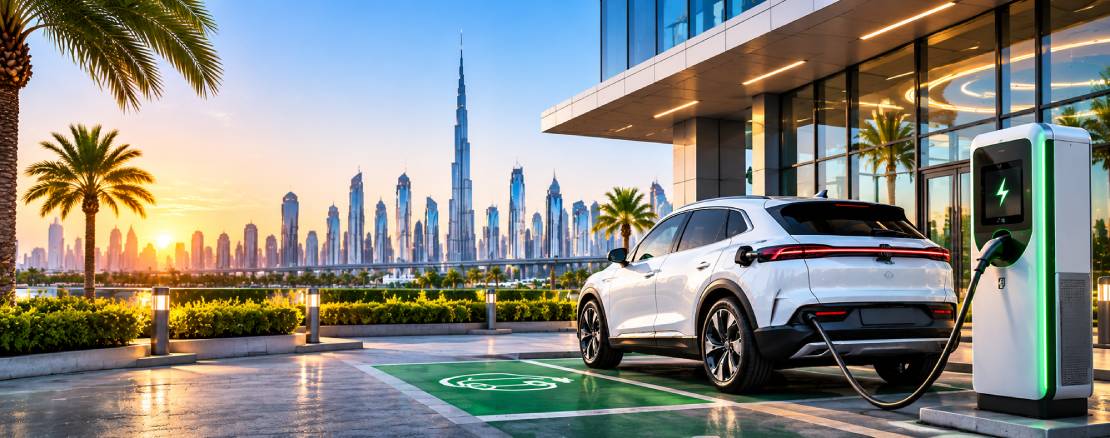

Electric cars are now a normal sight in Dubai car parks. You see them in staff bays, mall basements, hotel driveways and delivery depots. Their drivers want to charge wherever they already park.
That puts pressure on businesses and building owners. The commercial EV charging solutions UAE sites choose today will decide whether chargers become a selling point or a constant headache.
This guide explains Evolve B2B EV charging for four types of sites: workplaces, retail and destinations, residential buildings, and fleets. For each one, you will see what the site needs, how Evolve delivers it, and what to ask before you commit.
Why Businesses in Dubai Are Adding EV Charging Now
Demand is rising fast
The numbers have moved quickly. Dubai had 47,944 registered EVs by the end of 2025, compared with 37,486 a year earlier, which is growth of 27.9%.
Across the country, EVs made up around 9% of new vehicle sales in the UAE in 2025, according to an Arthur D. Little report. The International Energy Agency also found that the UAE accounted for nearly half of all EV sales in the Middle East in 2025.
Public charging alone cannot keep up
Public networks are growing. Dubai has 2,223 EV charging stations. That is still small next to tens of thousands of cars.
Most drivers charge where they park for hours. At work. At home. At the depot. That is where private sites come in.
The rules are now clearer, and stricter
Charging in Dubai is regulated. Independent charge points operators need a DEWA licence to run public EV charging, and there are two licence types: one for free charging and one for operators that collect payment from users.
New buildings face requirements too. Under Dubai Municipality’s Al Sa’fat green building system, Golden and Platinum Sa’fa buildings must provide charging equipment for 30% of their preferred parking spaces.
For owners, this means building EV charging Dubai projects now sit inside a formal framework. For EV charging for property developers, charging needs to be designed in early, not bolted on later. And the commercial EV charging solutions UAE businesses pick need to be compliant, networked and ready to scale.
Workplace Charging: Employees and Visitors
Office car parks are one of the best places to charge. Cars sit still for most of the day, so slow, steady charging works well.
What a workplace actually needs
AC charging for long stays
Most workplace EV charging Dubai setups use AC chargers. A car parked for a full working day does not need rapid charging. DEWA’s technical regulations allow AC charging equipment rated at up to 22 kVA per charge point, which is plenty for an eight-hour stay.
Not sure which type suits your site? Evolve’s guide to DC fast charging vs AC charging walks through the trade-offs.
Access control and fair use
Who can plug in? Only staff, or visitors too? Should cars move once fully charged?
This is where OCPP charging management earns its place. Networked chargers let you set user groups, time limits and access rules from one dashboard.
The DEWA question most offices miss
Many companies assume staff charging is “private”. It often is not. Under DEWA’s regulation, public chargers include an organization’s chargers used by staff or other stakeholders for their own cars.
That affects who can operate the chargers and whether you can charge for them. A proper business EV charger installation Dubai project settles this before any hardware is ordered.
Retail and Destination Charging: Malls, Hotels, Restaurants
Destination charging is about keeping customers on site. If a shopper can charge while they browse, they have a reason to stay.
Match charging speed to dwell time
Malls
Visits often last one to three hours. AC charging works for most bays, with a few faster chargers for short trips.
Hotels
Overnight guests suit AC charging perfectly. Charging is fast becoming a guest expectation. Evolve covers this in more depth in its guide to EV charging for hotels and hospitality in Dubai.
Restaurants and cafés
Stays are shorter here, often under an hour. A small number of higher-power chargers can make more sense than many slow ones.
Payments, branding and visibility
Public-facing sites must think about payments. Under DEWA’s 2025 EV charging regulations, all public operators must offer a pay-as-you-go option, and no public charger in the UAE can be limited to subscription-only access.
OCPP charging management helps here, as it connects chargers to payment and roaming platforms. Evolve B2B EV charging also includes customization options such as branding and user interfaces, so chargers can match your venue.
Residential Buildings and Communities: Shared and Individual Bays
Residential charging is the trickiest of the four. Many people share one electrical supply, and each wants fair access.
Shared bays
A pool of chargers is available to any resident. This is efficient, but it needs booking, access control and per-user billing to avoid disputes.
Individual (allocated) bays
A charger sits in a resident’s own bay. This is simpler for residents. The building still needs load management, so many chargers do not overload the supply at once.
Planning for Al Sa’fat
For EV charging for property developers, the bay count starts with Al Sa’fat. Evolve’s guide to Al Sa’fat 301.03 and load management shows how smart load sharing can help control the cost of electrical upgrades.
Older towers face a different challenge: retrofitting. Evolve’s guide to EV charging infrastructure for businesses and property owners covers what owners need to check first.
Quick check: will your chargers count as private or public? Under DEWA’s rules, private chargers only supply the household or organization whose DEWA account they are connected to, while public chargers must be operated by DEWA, a DEWA subsidiary or a DEWA-licensed CPO. Building-owned chargers used by residents, tenants or visitors should not be assumed to be private. Settle this before buying hardware. It shapes the charger choice, the billing model and who runs the site. |
Getting this right is the foundation of any building EV charging Dubai project.
Fleets and Depots: Scheduling, Load Management and Reporting
Fleet charging is less about convenience and more about operations. Every vehicle must be ready when its shift starts.
Scheduling
Vehicles return at different times with different battery levels. Good fleet EV charging UAE systems schedule charging around departure times, so the vans leaving first are charged first.
Load management
Ten vehicles plugged in at once can exceed a depot’s supply. Smart load management shares the available power, giving priority to vehicles that need it most. This can delay or avoid costly electrical upgrades.
Reporting
Fleet managers and finance teams need clear data. A well-built system should show:
- Energy used per vehicle and per session
- Charger availability and faults in real time
- Cost allocation by department or vehicle
- Usage trends to plan future expansion
OCPP charging management makes this easier, because OCPP chargers can share data with fleet software without locking you into one brand. Evolve’s full guide to fleet EV charging in the UAE covers depot, workplace and hub models in detail.
The Four Packages Side by Side
Every site is different. This comparison shows where each Evolve B2B EV charging package usually starts.
| Factors | Workplace EV Charging | Retail & Destination EV Charging | Residential Building EV Charging | Fleet & Depot EV Charging |
| Suitable locations | Corporate offices, business parks and staff parking facilities | Shopping malls, hotels, restaurants and retail centres | Residential towers, apartments and gated communities | Logistics centres, company depots and fleet parking facilities |
| Who uses the chargers? | Employees, office visitors and authorised staff | Shoppers, diners, hotel guests and public visitors | Residents, tenants, homeowners and their visitors | Company-owned electric cars, delivery vans and commercial fleets |
| Typical parking duration | 6–9 hours during a working day | 30 minutes to several hours, depending on the destination | Overnight or extended residential parking | Between shifts, overnight or during scheduled vehicle downtime |
| Recommended charger type | AC chargers for long-duration workplace parking | AC chargers for longer visits, with selected faster DC chargers for short stays | AC chargers for overnight charging and regular residential use | AC chargers for overnight charging and DC fast chargers for quick vehicle turnaround |
| Charging infrastructure requirements | Multiple charging bays, electrical capacity assessment and controlled charger access | Chargers positioned in accessible parking areas with sufficient capacity for customer demand | Shared or individually allocated charging bays, electrical load assessment and smart load sharing | Multiple charging points, depot power planning and centralized charging infrastructure |
| Key software and management features | Employee access control, charging schedules, usage tracking and fair-use policies | Pay-as-you-go payments, user authentication, charger availability and venue branding | Individual user billing, resident access management, booking and load balancing | Vehicle-level energy tracking, charging schedules, priority allocation and fleet reporting |
| Main business benefit | Supports employee convenience and workplace sustainability goals | Improves customer experience and adds value to retail and hospitality destinations | Adds property value, supports resident convenience and helps future-proof buildings | Reduces charging downtime and improves fleet operating efficiency |
| DEWA and regulatory considerations | Confirm whether staff and visitor charging falls under public charging regulations and applicable operator requirements | Assess public charging licensing, payment requirements and applicable DEWA regulations | Determine whether chargers serve private or public users and plan according to applicable building requirements | Confirm applicable charging classification, electrical approvals and operational requirements |
| First question to answer | How many employees and visitors need charging, and who can access the chargers? | How long do customers typically park, and should charging be free or paid? | Will residents use shared chargers or individually allocated charging bays? | When must each vehicle be fully charged and ready for its next shift? |
The best commercial EV charging solutions UAE sites can rely on start with these questions, not with a product catalogue.
The Evolve B2B Process: Assessment, Design, Install, Manage
Evolve, based in Dubai, follows four clear stages for every business project.
1. Assessment
It starts with a site visit. Evolve’s design and consulting service covers site assessment, equipment selection and project planning. This includes checking electrical capacity and confirming whether chargers will be private or public.
2. Design
Next comes the charging plan: bay count, AC or DC, power ratings and the load management approach. Your MEP consultant gets firm numbers to design around.
Why OCPP matters at this stage
OCPP is the open language chargers use to talk to management software. It is developed by the Open Charge Alliance, a non-profit founded in 2014 with more than 400 members worldwide, and OCPP 2.0.1 and OCPP 2.1 have both been approved as IEC international standards.
In Dubai, it is also a compliance point. DEWA’s technical regulations set OCPP 1.6J as the minimum for public chargers offering paid service, where applicable. Read Evolve’s guide on what OCPP is and why it matters before shortlisting hardware.
3. Install
A professional business EV charger installation Dubai project covers approvals, cabling, mounting, testing and commissioning. Evolve aims to deliver installs correctly, on time and on budget.
4. Manage
After handover, the work continues. Evolve includes an AMC with all its installations, along with remote monitoring, repairs and upgrades. Its online platform lets you monitor usage, generate revenue and manage access from anywhere, which is OCPP charging management in practice.
Dubai’s climate makes ongoing care essential. DEWA’s technical regulations list 55°C as the maximum ambient operating temperature for chargers. Facility managers can use Evolve’s EV charger maintenance guide as a checklist.
Cost is a real concern for many businesses. Evolve also offers financing and leasing options to spread the investment.
Related Evolve service: commercial EV charging solutions for UAE businesses
FAQs
Evolve offers end-to-end commercial EV charging solutions UAE businesses can use at workplaces, retail sites, residential buildings and fleet depots. This includes design and consulting, installation, maintenance with an AMC included, an online management system, branding options, and financing or leasing. See the full range on the Evolve for Business page.
Yes. Evolve’s online management system tracks usage, controls who can charge and supports revenue collection. Where shared chargers count as public and paid, DEWA rules require a licensed CPO to operate them, so Evolve plans for revenue to be collected through a DEWA-licensed CPO.
It depends on parking numbers, user demand and electrical capacity. For new building EV charging Dubai projects aiming for Golden Sa’fa, the requirement works out at about 2.1% of required parking bays. At Platinum, it is about 3%. Existing sites and fleets should size chargers around real usage, which Evolve confirms during the site assessment.
Yes. Every Evolve installation includes an annual maintenance contract (AMC), covering remote monitoring, repairs and upgrades, backed by round-the-clock support. This keeps workplace, residential and fleet EV charging UAE sites running through Dubai’s hot summers.