
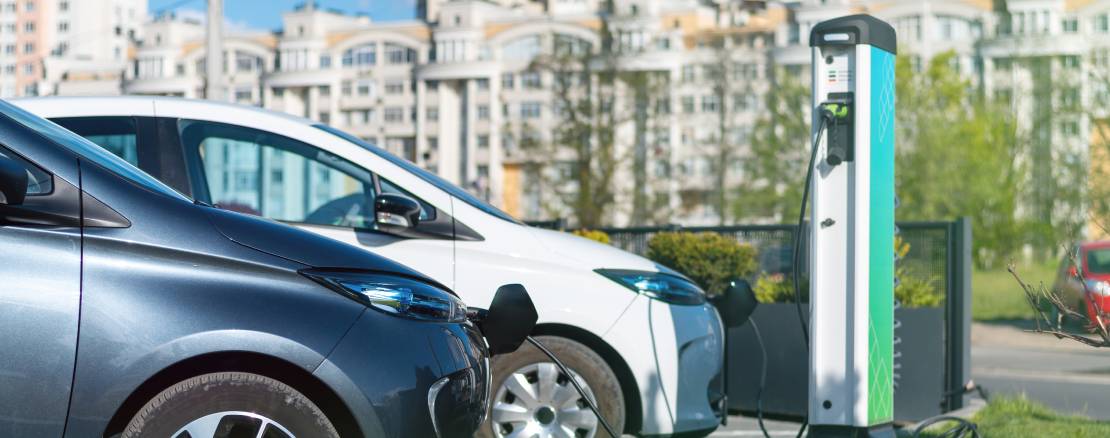

The number of EVs in Dubai reached over 40,600 by the end of the first half of 2025, and the charging network is racing to keep up, according to WAM.
For businesses and property owners, the real question has shifted. It is no longer “should we add chargers?” It is “how do we add them properly, legally and without overloading the building?”
This guide breaks down what EV charging infrastructure Dubai property owners need in 2026: charger types, planning by property, power capacity, and the DEWA rules that apply.
Quick Glance
- Dubai’s charging network hit 2,223 points by Q1 2026, but most charging still happens where cars park overnight or during work hours.
- AC chargers suit offices and residential buildings. DC fast chargers suit retail, hotels, fleets and high-turnover sites.
- Even private chargers need DEWA approval. Chargers used by employees or visitors can legally count as public.
- Electrical capacity is usually the biggest constraint. Load management lets you add more chargers without a major upgrade.
- Plan for expansion from day one: spare conduits, panel capacity and OCPP-ready hardware.
Why EV Charging Infrastructure Is Becoming Essential In Dubai
The growth curve is steep. Dubai had 25,929 EVs at the end of 2023, up from 15,100 in 2022. By mid-2025, that figure had passed 40,000, as reported by DEWA.
Public charging has grown fast too. Dubai had over 1,270 charging points in August 2025. By the end of the first quarter of 2026, that total reached 2,223, including DEWA’s EV Green Charger stations and stations run by licensed independent operators.
The long-term direction is clear as well. The UAE is targeting 50% of all vehicles on its roads to be electric or hybrid by 2050.
But public networks can only do so much. Drivers want to charge where their cars already sit for hours: at home and at work. That is why residential EV charging Dubai demand and workplace EV charging Dubai demand are growing faster than public charging alone can absorb.
Building EV charging infrastructure Dubai tenants, residents, and employees can rely on is becoming a basic amenity, not a bonus.
What Dubai’s Growing EV Network Means For Businesses And Property Owners
More EVs on the road means more EV drivers choosing where to live, work, shop and stay based on charging access.
New buildings are already being pushed in this direction. Under Dubai’s Al Sa’fat green building system, a minimum of 5% of parking spaces should be dedicated to green vehicles for the Silver ranking, rising to 7% for Gold and 10% for Platinum.
DEWA’s own headquarters offers a practical model for workplace EV charging Dubai setups. Of the 46 charging points installed at Al Shera’a, 40 AC chargers serve DEWA employees while six DC fast chargers are available for visitors. Slow chargers for long stays, fast chargers for short ones.
For owners of commercial EV charging stations Dubai sites like malls, hotels and offices, chargers can also become a revenue source. Our guide to commercial EV charging ROI covers the numbers, and hospitality operators can see how EV charging is becoming a guest expectation in Dubai hotels.
AC vs DC EV Chargers: Which Solution Is Right For Your Property?
This is the first decision in any EV charger installation Dubai project, and it shapes your costs, power needs and user experience.
DEWA’s technical rules set clear limits. AC chargers are capped at 32 A per phase and 22 kVA per charge point, with a maximum of two charge points per unit. DC chargers can go up to 500 kW using CCS2 connectors.
Factor | AC Chargers | DC Fast Chargers |
Power output | 7.4 kW to 22 kW | Typically 50 kW to 350 kW |
Typical charge time | Several hours (overnight or a full workday) | Roughly 20 to 60 minutes for a large top-up |
Best for | Villas, apartments, offices, staff parking | Malls, hotels, fuel stations, fleet depots |
Power demand on building | Low to moderate | High; often needs a supply upgrade |
Upfront cost | Lower | Significantly higher |
Public connector required by DEWA | Type 2 | CCS2 |
A simple rule of thumb: match the charger to how long cars stay parked. If they sit for 4+ hours, AC is almost always enough. If they stay under an hour, DC starts to make sense.
Most EV charging solutions UAE properties actually need are a mix of both. For a deeper breakdown, read DC fast charging vs AC charging in the UAE.
How To Plan EV Charging For Offices, Residential Buildings And Commercial Properties
Every property type has a different charging pattern. Here is how to think about each one.
- Offices: Cars park for 8 to 9 hours, so 7.4 kW or 11 kW AC chargers are ideal for workplace EV charging Dubai Start with a few bays and prewire more. Remember that employee-use chargers may fall under DEWA’s public charging rules.
- Apartment buildings: Residential EV charging Dubai in towers is a shared-power problem. Plan centrally with building management, use load management, and decide early how residents will be billed. An NOC from the building or developer is usually needed.
- Villas: A single 7.4 kW or 11 kW wall box usually covers overnight charging. Our villa EV charger page walks through the process.
- Malls, hotels and retail: Visitors stay 1 to 3 hours. A mix of AC bays and a few DC units works well for commercial EV charging stations Dubai sites, with app or RFID-based payments.
- Fleets: Charging depends on shift patterns and route lengths. See our fleet EV charging guide.
Across all of them, the process is the same: site survey, demand estimate, power check, charger selection, approvals, then installation.
Electrical Capacity, Load Management And Future Expansion Considerations
This is where many projects stall. Chargers are easy to buy. Power is harder to find.
Consider the math. Ten 22 kW AC chargers running at full speed need about 220 kW. Many existing buildings simply do not have that spare capacity.
Load management solves most of this. It shares available power across chargers in real time. When only a few cars are plugged in, each gets full speed. When all bays are busy, power is split so the building never exceeds its limit.
Dubai conditions add extra demands. DEWA requires chargers to operate at full capacity in ambient temperatures up to 55°C and relative humidity up to 95%. Chargers also cannot add distortion such as harmonics or flicker to DEWA’s grid. Poor-quality hardware is a real risk here.
To future-proof EV charging infrastructure Dubai projects:
- Lay extra conduits and cable trays to more bays than you need today.
- Size your distribution board for future chargers.
- Choose OCPP-capable chargers so software, billing and load management can be upgraded later. Read what OCPP is and why it matters.
Planning ahead costs little during EV charger installation Dubai work. Retrofitting later costs a lot.
DEWA Regulations And The Role Of Licensed EV Charging Infrastructure
Dubai has a clear rulebook, and it applies to more properties than most owners realize.
First, private does not mean exempt. Under Dubai’s EV charging regulation, anyone deploying private charging equipment at their premises must follow the procedure to obtain DEWA’s approval and comply with the EV Charging Technical Regulations.
Second, the definition of “public” is wide. For organisations, a charger accessible to employees or other stakeholders for charging their private vehicles falls under the definition of public charging equipment. That can bring CPO licensing into play for offices and residential communities.
Third, installation standards are strict. Chargers must be installed according to the IET Code of Practice for EV charging and the IET Wiring Regulations (BS 7671), and the connection process starts with a DEWA-enrolled consultant or contractor, followed by a building NOC for electricity.
For paid public charging, extra rules apply, including OCPP 1.6J support at minimum and provision for a DEWA smart electricity meter.
Getting this wrong can mean failed inspections or unlicensed operation of commercial EV charging stations Dubai regulators will act on. Our detailed guide to UAE EV charger regulations for 2026 covers licensing fees and emirate-by-emirate rules. You can also compare DEWA’s Green Charger network with private chargers.
Licensed, compliant EV charging infrastructure Dubai installations protect your investment, your insurance and your tenants.
How Evolve Helps Businesses Plan, Install And Maintain EV Charging Stations
Evolve is a Dubai-based EV charging company working from Al Quoz, serving homeowners, businesses and government entities across the Emirates.
Our end-to-end EV charging solutions UAE clients use cover:
- Design and consulting: Site assessment, load analysis, charger selection and project planning.
- Installation: Compliant EV charger installation Dubai work, including approvals and commissioning.
- Maintenance and support: AMC is included with all our installations, plus remote monitoring, repairs and upgrades.
- Revenue and management: An online system to track usage, manage access and monetize chargers.
We also flag the public vs private question early, before it becomes a licensing issue. Explore Evolve for Business, browse our products, or see our full services. Ready to start? Contact us for a site survey.
FAQs
It depends on how many drivers use the site and how long they stay. A practical benchmark is Dubai's Al Sa'fat guidance for new buildings: 5% of parking dedicated to green vehicles at Silver level, rising to 10% at Platinum.
AC chargers are best for most offices and residential buildings. Cars park for hours, so 7.4 kW or 11 kW AC units deliver a full charge without straining the building's power supply.
Yes. Both private and public chargers in Dubai need DEWA approval, and installation must be done through a DEWA-enrolled contractor.