
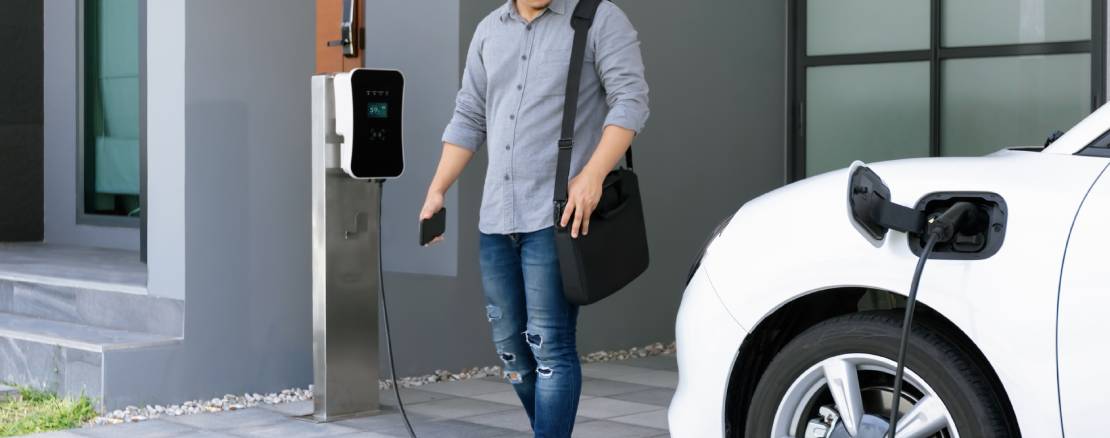

There is no single new law called EV charger regulations UAE 2026. What is actually happening is that the framework built across 2024 and 2025 is now being enforced, copied into more emirates, and backed by real penalties.
For homeowners, that mostly means one thing. Your charger and your installer both need to be approved. For businesses and installers, the bar is higher, and getting it wrong now has a price attached.
Here is what changed, what is tightening, and what to check before your next installation.
Quick Glance
- Dubai: Private and public EV chargers require approval, with strict technical and equipment requirements.
- Abu Dhabi: EV chargers must follow the ADQCC conformity route and utility registration requirements.
- Sharjah: Prior approval is mandatory, with fines of up to AED 10,000 for unlicensed operation.
- For homeowners: Use certified equipment and an approved installer, and obtain an NOC where required.
- For businesses: Check whether your charger is legally public and whether CPO licensing applies.
How the 2024 Dubai EV Charging Infrastructure Regulation Set the Foundation
Dubai’s rulebook is the Electric Vehicles Charging Infrastructure Regulation for the Emirate of Dubai. It was introduced on 30 September 2024 and updated to Version 1.1 in December 2024. It did three things that still define DEWA EV charger compliance today.
It split every charger into two categories. Private Charging Equipment is accessible only to the household or organization of the DEWA electricity customer whose account it is connected to. Everything else is Public Charging Equipment.
It made licensing mandatory. Operating public charging infrastructure without either controlling equity participation from DEWA or a CPO Licence issued by DEWA is not permitted in the Emirate. That is the legal spine of CPO licensing UAE operators now work under.
It keeps private chargers inside the net. Any person deploying private charging equipment at their premises must follow the applicable procedure to obtain DEWA’s approval and comply with the EV Charging Technical Regulations. Private does not mean unregulated.
One definition catches businesses off guard. In the case of organizations, a charger accessible to employees or other stakeholders for charging their private vehicles falls under the definition of Public Charging Equipment.
The regulation applies across Dubai, including free zones and special development zones, DIFC included.
What Is Tightening In 2026: Safety, Interoperability, Scalability
The real teeth arrived after the 2024 regulation, not inside it. Anyone searching for EV charger regulations UAE 2026 should be looking at two documents and one new emirate-level law.
DEWA’s EV Charging Technical Regulations, Version 1.0, published May 2025. This is where the specifics live. Public charging equipment is limited exclusively to AC units with Type-2 connectors and DC units with CCS2 connectors. SAE J1772, Type-1, CCS1, NACS, CHAdeMO, and GBT are strictly prohibited. If you are weighing hardware, our breakdown of AC versus DC charging for UAE businesses covers the practical trade-offs.
Equipment also has to survive local conditions. DEWA requires EVSE to operate at full capacity at ambient temperatures up to 55°C and relative humidity up to 95%, with IP54/IK10 protection and a 30 mA Class A residual current device. Installation must follow the IET Code of Practice for Electric Vehicle Charging Equipment Installations and the IET Wiring Regulations, BS 7671.
Gulf News reported on Sharjah’s new law. Executive Council Resolution No. 15 of 2026 applies across all areas of Sharjah, including free zones and private developments. It bans installing or operating EV charging stations without prior approval, with fines up to AED 10,000 for operating without a license and AED 5,000 for failing to meet approved safety and technical standards.
Abu Dhabi runs its own conformity route through ADQCC, which we explain in detail in our guide to what “ADQCC certified” actually means.
Where The Rules Stand, Emirate By Emirate
What to check | Dubai | Abu Dhabi | Sharjah |
Main rulebook | EV Charging Infrastructure Regulation v1.1 (Dec 2024) + EV Charging Technical Regulations v1.0 (May 2025) | ADQCC conformity scheme for EVSE, plus utility registration | Executive Council Resolution No. 15 of 2026 |
Approval before installing | Required for public and private equipment | Required; chargers registered with ADDC or AADC | Required; installation without approval is banned. |
Paid public charging | DEWA, its subsidiaries, or a DEWA-licensed independent CPO only | Regulated by the emirate’s authorities and utility | Licensed operators only |
Public tariff | AED 0.70/kWh AC, AED 1.20/kWh DC (+VAT) | The federal unified tariff applies. | AED 0.70/kWh AC, AED 1.20/kWh DC (+VAT) |
Named penalties | Enforcement action by DEWA | Enforcement by relevant authority | Up to AED 10,000 unlicensed; AED 5,000 standards breach |
Overstay rules | Set in operator terms; overstay charges permitted | Set by operator | 10-minute grace, then Dh2/minute, capped at 60 minutes |
Sharjah also fines non-electric vehicles AED 1,000 for occupying charging bays, and Sharjah Police will impound any vehicle left in an EV charging space for more than 24 hours.
Charge Point Operator (CPO) Licensing And What It Means For Public Charging
A Charge Point Operator is anyone running charging equipment that people outside your own household or organization can use. DEWA issues two license types: one for CPOs offering free EV charging and one for CPOs collecting payments from end users. The compliance deadline for existing operators was 31 March 2025.
That window is closed. CPO licensing UAE enforcement is now business as usual, not a grace period.
The annual charges are published. AC public charging equipment costs AED 500 per charging port per year, roughly AED 1,000 for a typical two-port charger. DC is AED 100 per kW of output capacity, capped at AED 7,500 per port, which works out to about AED 15,000 a year for a typical 150 kW two-port unit.
There are commercial restrictions too. Operators cannot collect subscription fees for charging access, cannot charge EV users more for parking than non-EV users, and must show a breakdown on invoices covering the DEWA tariff, fuel surcharge, CPO fee, overstay charges, and VAT. Independent CPOs must also source electricity exclusively from DEWA’s distribution system.
Worth knowing if you are comparing what the public network offers against a private setup, which we cover in DEWA Green Charger network vs private EV chargers.
If you manage a mall, hotel, office tower, or residential community, Evolve for Business is where this conversation usually starts.
Is Smart Charging Becoming A Requirement, Not An Option?
For public paid charging, connectivity is already mandatory. Talk of a smart charging mandate UAE-wide is not speculation at that level; it is written into the technical regulations.
DEWA requires public EVSEs providing paid services to be compatible with the operator’s Charge Point Management System and to report to it over OCPP, at a minimum of version 1.6J or higher. If OCPP is new to you, start with what OCPP is and why it matters.
Alongside that, public paid chargers need:
- A unique EVSE-ID matching the one submitted in the licence application, visible on the outside of the unit
- At least one authorization method: RFID, QR code, the operator’s app, or Plug and Charge under ISO 15118
- Certified internal energy meters and a provision for a DEWA smart electricity meter
- Data handling that follows Dubai Data Law
Sharjah has landed in the same place. Public stations there must carry digital payment systems and remote monitoring technologies.
For home chargers, there is no hard smart-charging rule yet. But every direction of travel in UAE EV charging law 2026 points the same way, and a connected charger costs very little more than a non-connected one today. Buying a non-connected unit in 2026 is a decision you will likely revisit.
What This Means If You Are Installing A Home Or Business Charger Now
Most of this is invisible to homeowners if you use a compliant installer. It becomes very visible if you do not.
Practical checklist before you commit:
- Confirm the charger is certified and grid-compatible. IEC 61851 and IEC 62196-2 Type 2 are the baseline for Dubai. Abu Dhabi expects ADQCC certification.
- Confirm your installer is DEWA-enrolled (or approved by the relevant utility outside Dubai). This is the single biggest failure point.
- Check your load, not just your parking spot. AC units are capped at 32 A per phase and 22 kVA per charge point under DEWA’s spec.
- Get the NOC early if you are in an apartment building or a managed community.
- Ask who the charger is for. If employees, tenants, or visitors use it, you may be operating public charging equipment, not private.
- Keep your paperwork. Installation certificate, warranty, and commissioning report.
Note: Generating electricity off-grid, including from renewables, and using it to power EV charging equipment is not permitted in Dubai except in cases explicitly authorized by DEWA. If solar was part of your plan, read solar-powered EV charging at home before you spec anything.
Fleet operators have an extra layer to think about, covered in our fleet EV charging guide. And for villa owners, our home EV charger page walks through the full process.
How Evolve Keeps Installations Compliant As Regulations Evolve
Compliance is not a one-time checkbox. DEWA is empowered to issue and amend the EV Charging Technical Regulations from time to time, and Sharjah’s 2026 resolution explicitly allows authorities to issue further technical guidelines.
That is why we treat EV charger regulations UAE 2026 as a moving target rather than a fixed spec sheet.
Our approach is straightforward. We spec only certified hardware that meets the connector, protection, and temperature requirements for the emirate you are in. We handle the site survey, load assessment, and approvals through licensed contractors. And we default to OCPP-capable equipment so a future smart charging mandate UAE operators face does not turn your installation into a replacement job.
For businesses, we also flag the public-versus-private question early, before it becomes a licensing problem. See our services or talk to us about your site.
The market is scaling fast. DEWA’s EV Green Charger network reached 2,223 charging points across Dubai by the first quarter of 2026, including stations licensed by DEWA in collaboration with government and private sector entities. Regulation is scaling with it.
FAQs
If it was installed by an approved contractor with certified equipment and it is for your own household, you are generally fine. Existing private installations are not being retroactively banned. Two situations do need review: if your charger was installed informally or by an unapproved electrician, and if other people now use it. A charger that started as private and is now used by employees or neighbors may sit on the wrong side of the definition. Routine servicing helps here too, as our EV charger maintenance guide explains.
A CPO is anyone operating public charging equipment. In Dubai, an independent CPO is any person other than DEWA and its subsidiaries operating public charging equipment, and they must hold a valid CPO Licence. It does not apply to a standard home charger used by your own household. It can apply to a villa owner who charges neighbors, a building that opens its chargers to visitors, or a company offering employee charging. Under DEWA EV charger compliance rules, the test is who can access it, not where it is installed.
For public paid charging, effectively yes. DEWA requires those units to communicate with a Charge Point Management System over OCPP 1.6J or higher. For private home chargers, there is currently no explicit mandate. But given where EV charger regulations UAE 2026 are heading and how little a connected unit adds to the bill, specifying OCPP-capable hardware now is the safer call.