
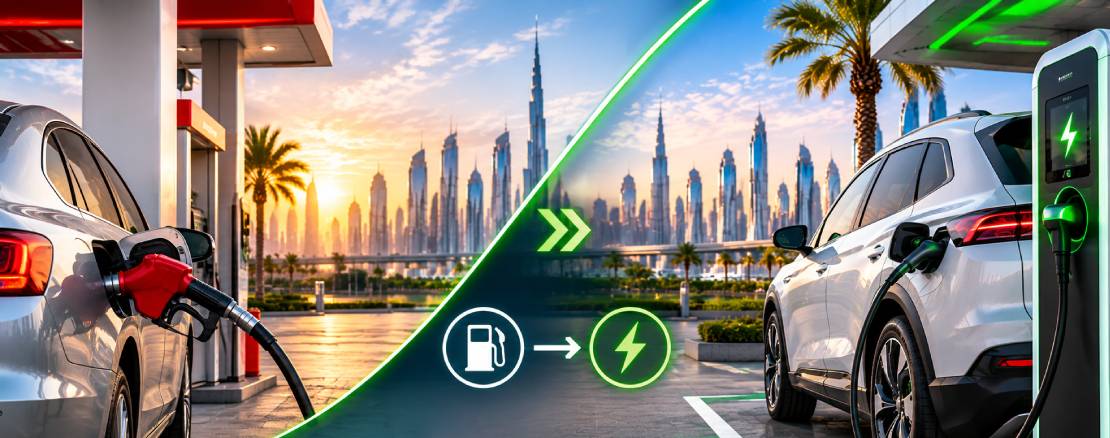

If you’re thinking about the petrol-to-electric car switch, a lot of UAE drivers are doing the same. According to Arthur D. Little’s 2026 Global Electric Mobility Readiness Index, EVs made up about 9% of new car sales in the UAE in 2025 (Khaleej Times). In Dubai, the number of green vehicles (EVs and hybrids together) reached 112,813 by August 2026.
Most first-time buyers still ask the same three questions. Will it feel different to drive? How do I “fill up”? And what happens to the battery in August?
This guide covers the real EV vs petrol car differences using current UAE prices and data, so you know what to expect before you buy. It also covers what stays the same, which surprises a lot of new owners.
What Changes When You Make the Petrol to Electric Car Switch?
Three things change: how the car drives, how you fuel it, and how often it goes to a workshop. Let’s go through them one at a time.
The EV Driving Experience Feels Quieter and Quicker
The first thing most people notice about the EV driving experience is how quiet it is. You hear no engine at a red light and very little at motorway speed. On Sheikh Zayed Road, you’ll mostly hear the tyres and the wind.
The second thing is how the car pulls away. An electric motor gives you its full pulling power the moment you press the pedal. There are no gear changes to wait for, so even a large family SUV feels quick when you’re joining traffic or overtaking.
Braking Works a Little Differently
When you lift your foot off the accelerator in an EV, the car slows down by itself. This is called regenerative braking. The motor works in reverse and sends some energy back into the battery.
Most EVs let you choose how strong this effect is. Some drivers set it high and barely touch the brake pedal in city traffic. It takes a day or two to get used to, and it’s one of the EV vs petrol car differences people expect least.
Servicing Gets Simpler
An electric car has far fewer moving parts than a petrol one. It has no engine oil, spark plugs, fuel filter or gearbox oil to change. Regenerative braking does a lot of the slowing down, so brake pads usually last longer too.
The battery makes EVs heavier, so tyres can wear a little faster. Check tyre pressure and tread regularly, especially in summer when roads get very hot.
Charging vs Refuelling: The Biggest Change to Your Daily Routine
For most owners, charging vs refuelling is the change they feel every day. With a petrol car, you drive to a station when the tank runs low. With an EV, you plug in when you park at home for the night and leave with a full battery in the morning.
This is why the petrol-to-electric car switch works best when you can charge at home. Most of your charging happens while you sleep, and public chargers become something you use on trips.
How Long Does It Take to Charge an EV at Home?
That depends on two things: your home’s power supply and the charger you install.
First, two terms you’ll keep seeing. A kilowatt (kW) is how fast power flows into the car. A kilowatt-hour (kWh) is how much energy the battery holds, much as litres measure a fuel tank.
Single-Phase vs Three-Phase Homes
Homes with a single-phase supply can usually take a 7-kW charger. For a typical family SUV, that adds about 35 km of driving for every hour it’s plugged in. Overnight, that covers most people’s daily driving with room to spare.
Villas with a three-phase supply can usually take an 11 kW or 22 kW charger. Many EVs can only accept up to 11 kW from a home charger, though, so a 22-kW unit won’t always charge faster. It pays to match the charger to your car. Our home EV charger sizing guide explains this for popular brands such as BYD, Jetour and Geely. Evolve’s villa EV chargers go up to 22 kW on a three-phase supply, with lower-power options for single-phase homes.
When Do Public Fast Chargers Make Sense?
Public DC fast chargers are for road trips, and for the odd day you forget to plug in. They’re much quicker than charging at home. In a UAE test reported by Zig wheels in September 2026, a Tesla Model 3 charged from 9% to 80% in 32 minutes at a DEWA fast charger.
The network keeps growing. Arthur D. Little puts the UAE at about 2,800 public charging points, around 1,250 of them fast DC points. DEWA’s EV Green Charger network alone reached 2,223 points in early 2026.
So, when you compare charging vs refueling, the EV is only slower when you’re away from home. To decide when each option fits, see our comparison of DEWA Green Chargers vs private home chargers. Planning a weekend away? Our winter EV road trip guide covers charging stops for Hatta, Jebel Jais, Abu Dhabi and Oman.
EV vs Petrol Car Differences at a Glance
This table compares the two on the things that affect your daily life and your spending.
Comparison Factor | Petrol Car | Electric Car (EV) |
Energy source | Uses petrol to power an internal combustion engine. | Uses electricity stored in a rechargeable battery to power an electric motor. |
Where you refuel or recharge | Refuel at ENOC, ADNOC, Emarat or other petrol stations across the UAE. | Recharge at home using a dedicated EV wall charger or at public AC and DC charging stations. |
Typical refuelling or charging time | Around 5 minutes to refill a conventional petrol tank, excluding queues. | Usually charged overnight at home. DC fast charging can take approximately 30–45 minutes from 10% to 80%, depending on the vehicle and charger. |
Energy consumption per 1,000 km | Approximately 90 litres of petrol for a vehicle consuming 9 L/100 km. | Approximately 200 kWh for an EV consuming 20 kWh/100 km, excluding charging losses. |
Energy cost per 1,000 km in Dubai | AED 364, using Special 95 petrol at AED 4.04 per litre. | AED 61–92 at home, AED 147 on public AC charging or AED 252 on public DC charging. |
How energy prices change | UAE petrol prices are reviewed monthly and fluctuate with global fuel markets. | DEWA residential electricity uses consumption-based slab rates. Fuel surcharges may change. Public EV charging follows applicable operator tariffs. |
Routine servicing requirements | Requires engine oil changes, oil filters, spark plugs and other engine-related maintenance. | Does not require engine oil or spark plug changes. Tyres, brakes, cooling systems and other components still need maintenance. |
Braking system | Relies mainly on conventional friction braking, which causes brake pad and disc wear. | Uses regenerative braking to recover energy during deceleration, potentially reducing friction-brake wear. |
Performance in UAE summer heat | Air-conditioning increases fuel consumption, and heat places additional demands on the cooling system. | Air-conditioning and battery cooling consume electricity and can reduce driving range. Actual reduction varies by vehicle, temperature and driving conditions. |
Driving experience | Engine noise, gear changes and acceleration characteristics vary by vehicle. | Generally quieter, with smooth acceleration and immediate electric-motor torque. |
Environmental impact during driving | Produces exhaust emissions while operating. | Produces no tailpipe emissions, although electricity generation and vehicle manufacturing still have environmental impacts. |
Best suited for | Drivers who prefer quick refueling or regularly travel routes where charging access is limited. | UAE commuters, villa owners, families with private parking and drivers who can charge at home overnight. |
*Family SUV at 9 litres per 100 km on Special 95 at AED 4.04 (November 2026), against an electric SUV using 20 kWh per 100 km. home figures use DEWA residential slabs of 23 to 38 fils per kWh, before the fuel surcharge. Public rates of AED 0.70 (AC) and AED 1.20 (DC) per kWh include VAT. The method follows Yallamotor’s 2026 UAE running-cost analysis, updated with November fuel prices.
If you’re weighing up the petrol-to-electric car switch, running costs are where the numbers are clearest. Over 20,000 km a year, the petrol SUV uses about AED 7,270 in fuel. The electric SUV charged at home uses about AED 920 to AED 1,520 in electricity.
Fuel prices also move every month. Special 95 went from AED 4.28 in October to AED 4.04 in November 2026 (Khaleej Times). When you charge at home, your cost stays the same from month to month.
What EV Range UAE Drivers Can Realistically Expect
Range is how far an EV can go on a full battery. Many popular models on sale in the UAE, such as the Tesla Model Y and BYD Seal, are rated well above 400 km.
Is Range Anxiety a Real Problem in the UAE?
For daily driving, rarely. A round trip from Dubai Marina to Downtown is about 50 km. A return trip from Dubai to Abu Dhabi city, roughly 280 km, can fit within one charge for many models.
Where EV range UAE drivers do need to plan is on longer trips and in the hottest months.
How Does an EV in UAE Summer Heat Perform?
Heat does reduce range. Recurrent, a company that tracks battery data from thousands of EVs, found that cars can lose 20% to 30% of their range when temperatures rise above 35°C (Electrek). Comparative testing reported by Zigwheels in 2026 put the loss at 15% to 25%.
Most of that energy goes to two places: the air conditioning and the car cooling its own battery. According to Tesla’s data, cabin AC can draw 1 to 3 kW in normal conditions and up to 6 kW in extreme heat. A petrol car also burns extra fuel for AC. The difference is that an EV shows it clearly on the range display.
The practical takeaway for an EV in UAE summer heat is to plan for about 70% to 75% of the rated range on the hottest days. That way the EV range UAE summers allow never catches you short.
Does the Heat Damage the Battery or the Charger?
Most modern EVs have liquid cooling that keeps the battery in a safe temperature range, even when the car is parked in the sun. If the battery gets too hot, the car slows charging down to protect it. Many manufacturers also offer battery warranties of around eight years, so check the terms for your model.
Home chargers in Dubai have to meet DEWA’s technical rules, which include being rated to work at temperatures up to 55°C. Where the charger goes and how its cable is routed still make a difference, and so does regular care. Our EV charger warranty and maintenance guide explains what to expect.
Your Summer EV Checklist ● Cool the cabin while the car is still plugged in, so the cooling runs on home power rather than the battery. ● Park in the shade or a covered garage when you can. ● Charge overnight, when it’s cooler, using your charger’s schedule. ● For everyday driving, keeping the battery between about 20% and 80% is gentler on it. ● On long summer trips, plan your stops around 70% of the rated range. |
What Doesn’t Change After the Switch
A lot stays the same, and that makes the petrol to electric car switch easier than most people expect:
- You still register and insure the car, and renew the registration as usual.
- Salik tolls and paid parking still apply.
- Tyres, wipers, cabin filters and the AC system still need regular checks.
- You can still go on long road trips. You plan your stops around chargers instead of petrol stations.
- The basics behind the wheel feel familiar. Steering, seats, cruise control and safety features work the way you’re used to, so the EV driving experience feels new without feeling strange.
The one real difference among the EV vs petrol car differences is that your parking spot at home becomes your main place to “fill up”. That’s why home charging needs some planning.
Getting Your Home Ready for an Electric Car
If you’re making the petrol-to-electric car switch this year, sort out home charging before your EV arrives.
In Dubai, a private home charger needs DEWA approval and has to be installed by a DEWA-enrolled contractor. In an apartment or managed community, you’ll also need a no-objection certificate (NOC) from the building or developer. Our guide to UAE EV charger regulations for 2026 explains the rules emirate by emirate.
A smart charger is worth thinking about. It lets you schedule charging for the night and see your energy use in an app. It can also balance power so the charger doesn’t overload your home’s supply when the AC and appliances are running. Smart EV Chargers Explained covers this in plain terms. If you rent, find out whether you can take your charger with you when you move.
With the right setup at home, charging vs refueling stops feeling like a chore you have to plan around.
How Evolve Takes the Guesswork Out of Home Charging
Evolve installs home and business EV chargers across Dubai and the UAE. You don’t need to know anything about phases, amps or approvals to get started, because the process begins with a free home charging assessment.
An Evolve specialist checks your parking area, power supply and cable route. They then recommend a charger based on your car, how far you drive each day and any future plans, such as a second EV. The team handles installation and safety checks, sets up the app and charging schedule, and shows you how everything works at handover. After that, you get ongoing maintenance and support if anything needs attention.
Evolve’s villa chargers have a weatherproof design for outdoor driveways and carports, so they’re built for running an EV in UAE summer heat. They connect over Wi-Fi, Bluetooth, Ethernet or 4G and include energy monitoring and load balancing.
If you also look after cars for a company, Evolve for Business covers workplace and fleet charging.
Ready to make your petrol-to-electric car switch simple from the first day? Book a free home charging assessment with Evolve.
FAQs
You replace petrol station stops with regular charging, usually overnight at home. Electric cars also have quieter acceleration, regenerative braking and fewer engine-related servicing tasks.
Charging time depends on your car and available power. A single-phase home often supports around 7 kW, while a three-phase supply may support 11 kW or 22 kW. The car's onboard charger limits the actual AC charging speed.
Yes. Cabin air conditioning and battery cooling increase energy use in very hot weather. The article recommends planning for reduced range, parking in shade and pre-cooling while the vehicle is plugged in.
Yes. The article states that private chargers must comply with DEWA requirements and be installed by a DEWA-enrolled contractor. Apartments and managed communities may also require a building or developer NOC.