
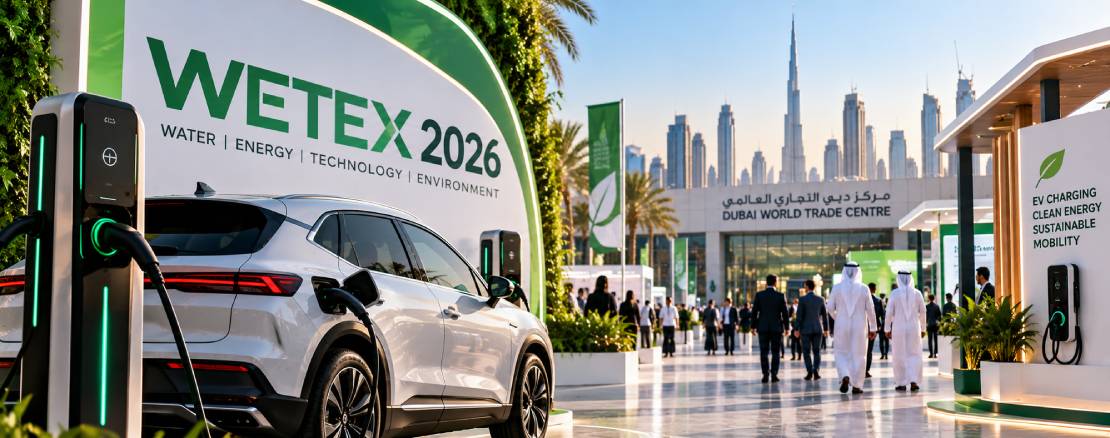

Dubai’s biggest energy exhibition is less than three weeks away. This year, EV charging sits closer to the centre of it than ever.
If you’re planning a smart EV charger installation Dubai homes and businesses can rely on for years, WETEX 2026 is worth paying attention to. Not for the stands. For the direction it signals.
Here’s what the WETEX Green Mobility Zone focuses on, what it means for your villa or car park, and how to buy a charger in 2026 that won’t feel outdated by 2028.
Why WETEX (20–22 October, DWTC) Matters to Anyone Planning a Charger
WETEX is DEWA’s own show. That’s what makes it useful.
DEWA runs Dubai’s grid, sets the rules for charger approvals and operates the public charging network. When it puts EV charging in a headline zone, it shows you where infrastructure and policy are heading.
The scale is serious. The previous edition drew 3,100 exhibitors and more than 50,000 visitors. This year, the Green Mobility Conference runs on all three days in Hall 8.
For homeowners and businesses, WETEX 2026 EV charging displays act as a preview. They show which EV charger technology Dubai suppliers will push over the next 12 to 24 months. Most of it isn’t futuristic. Its features are already available in good smart chargers today.
We covered a similar shift in what Middle East Energy 2026 signalled for EV charging in the UAE. WETEX takes that conversation further, with the utility itself in the room.
What DEWA’s Green Mobility Zone Focuses On: Charging, Load Management and Fleets
According to WAM, the zone will connect transport operators, utilities, investors and technology providers. DEWA’s MD and CEO Saeed Mohammed Al Tayer framed the goal as an integrated ecosystem combining clean energy, advanced infrastructure, digital technologies and investment models.
In plain terms, the WETEX Green Mobility Zone covers three layers:
- The hardware: from home AC wallboxes to DC fast chargers.
- The digital layer: apps, networked chargers and load management.
- The fleets: depots, workplaces and commercial vehicles.
There’s also a clear trend from last year. In 2025, the exhibition widened its focus to smart grids and AI. That matters for DEWA EV charging 2026 planning, because chargers are increasingly treated as grid-connected devices, not just appliances on a wall.
Global EV Growth Context and What It Means for UAE Charger Demand
The global numbers are big. EV sales are projected to hit 23 million in 2026, around 28 per cent of all car sales. Gartner forecasts 116 million electric vehicles on the world’s roads in 2026, a 30 per cent rise.
Dubai is following the same curve. By mid-2025, the emirate had more than 41,000 electric vehicles. DEWA’s Green Charger programme had 23,600 registered users by mid-January 2026.
The key Dubai EV infrastructure trends point one way: the public network is growing, but EV ownership is growing alongside it. Most charging still happens where cars sit longest, at home and at work.
Cost backs this up. DEWA’s public AC charging costs AED 0.7 per kWh plus VAT, and DC charging costs AED 1.2 per kWh plus VAT. Home charging is simply added to your regular DEWA bill at standard residential rates.
That’s why demand for smart EV charger installation Dubai villas and offices is rising. For a side-by-side view, read our guide on DEWA Green Chargers vs private home chargers.
Load Management and Grid Capacity: The Theme Homeowners Should Care About
This is the most practical takeaway from WETEX for villa owners.
An EV charger is one of the largest loads in a home. Add a Dubai summer, with AC units running all day, plus cooking and water heaters, and your main supply can get stretched.
Without control, two things can happen. Your main breaker trips, or you’re told you need a costly supply upgrade.
Load management solves this. A smart charger measures your home’s total consumption in real time. When the house is busy, it slows charging down. When demand drops, it speeds back up. Your car is still full by morning.
This is exactly the kind of EV charger technology Dubai utilities care about, because it keeps homes from adding sudden spikes to the grid.
One rule doesn’t change. DEWA states that home chargers must be installed by DEWA-approved electrical contractors. A proper smart EV charger installation Dubai homeowners can trust starts with a load assessment, not just a wall mount.
Our explainer on smart EV chargers, app control and load balancing goes deeper. If you’re ready to plan, start with our home EV charger solutions for villas.
Fleet and Depot Charging Signals for Businesses
Fleets are a big part of this year’s story. WAM notes that fleets help drive electric mobility because their fixed routes and heavy use let operators measure costs and infrastructure efficiency.
Government targets add pressure. Dubai government entities must make 20 per cent of new vehicle purchases electric or hybrid from 2025, with that rising to 30 per cent from 2030.
DEWA’s own headquarters offers a useful template. It has 40 AC charging points for employees and six DC points for visitors. Slow AC where cars park all day. Fast DC where they don’t.
If you’re heading into fleet charging WETEX sessions, go in with these questions:
- Dwell time first: How long do vehicles actually sit? This decides AC vs DC, not the brochure.
- Open software: Ask about OCPP so you’re not locked into one platform if you switch providers.
- Shared load: Plan load management across all chargers from day one, not charger by charger.
- Room to grow: Lay cabling and conduits for future bays now. Trenching twice costs more.
- Usage data: Look for reports and access control so you can track costs per driver or tenant.
- Approvals: Organisations and developers need DEWA approval before installing, operating or maintaining any EV charging station.
These are among the most practical Dubai EV infrastructure trends for businesses. For more detail, see our guides on fleet EV charging in the UAE, DC vs AC charging for businesses and why OCPP matters.
Install Now or Wait? How to Future-Proof a Charger Bought in 2026
Install now. Here’s why.
The core hardware standard is settled. DEWA’s own wall-box units are 22 kW AC chargers with a Type 2 socket; the same connector used across most new EVs in the UAE.
What keeps changing is software. And a connected charger gets software updates. A “dumb” one doesn’t.
So, the real question isn’t when to buy. It’s what to buy. Much of the WETEX 2026 EV charging conversation comes down to the gap below.
Feature | Basic charger | Future-ready smart charger |
Connectivity | None, plug and charge only | Wi-Fi or Ethernet with app control |
Load management | Fixed output, can overload supply | Dynamic load balancing with your home’s demand |
Software standard | Closed or none | OCPP-compatible, works with multiple platforms |
Updates | Stays as bought | Over-the-air firmware updates |
Scheduling | Manual | Timed and off-peak charging |
Usage data | None | Session history and energy reports |
Solar readiness | Not supported | Can work alongside solar systems on supported models |
Certification | Varies | UAE-certified hardware, installed by an approved contractor |
Buy from the right-hand column, and most new EV charger technology Dubai suppliers introduce will reach you through updates, not a replacement.
Check certification too. Our guide to what “ADQCC certified” actually means explains what to look for. Thinking about solar later? Read whether solar-powered EV charging is realistic in Dubai yet.
How Evolve Aligns Installations with Where the Market Is Heading
The themes in the WETEX Green Mobility Zone line up closely with how Evolve already works.
Every smart EV charger installation Dubai project at Evolve starts with design and consulting. That means a site assessment, equipment selection and project planning before anything is mounted.
For villas, that assessment shapes the load management setup. For businesses, it covers networked chargers, access control and room to scale.
After installation, Evolve’s maintenance and support cover remote monitoring, repairs and upgrades. Its management system lets businesses track usage, manage access and earn revenue from chargers. Financing and leasing options are available for larger rollouts.
That covers the full picture Dubai EV infrastructure trends are pointing to: grid-aware homes, connected workplaces and fleet-ready depots.
Explore Evolve’s EV charging services or Evolve for Business. When you’re ready, book your smart EV charger installation Dubai consultation.
FAQs
WETEX is DEWA's annual Water, Energy, Technology and Environment Exhibition. The 28th edition takes place from 20 to 22 October 2026 at Dubai World Trade Centre. Its WETEX Green Mobility Zone showcases charging technology and fleet solutions, which makes it a useful preview of DEWA EV charging 2026 priorities and the products EV owners will see next.
For most homes, no. The Type 2 AC standard is settled. Most new EV charger technology Dubai suppliers launch arrives as software features, which a connected, OCPP-compatible, load-managed charger can receive through updates. Waiting only means more months on public charging.
Yes. Evolve's design and consulting service assesses your electrical supply before recommending a charger, including smart models with load balancing. It covers single-villa installs through to multi-bay commercial and fleet charging WETEX-style depot setups. Start with home EV chargers or business charging solutions.