
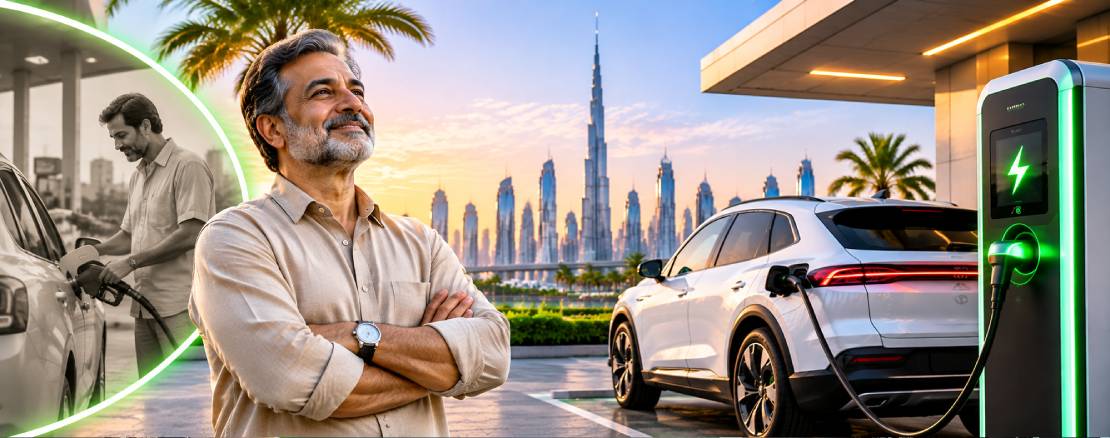

You know your petrol car inside out. You know how it sounds when you start it, how it pulls when you overtake on Sheikh Zayed Road, and how long the weekly stop at the petrol station takes. Thirty years of habits don’t disappear overnight.
So when you start thinking about your first electric car, the questions are practical ones. Will it feel strange to drive? Where will you charge it? Will it get you to Abu Dhabi and back in August?
This guide answers those questions in plain language. It covers what to expect from an EV in your first few weeks, what changes in your daily routine, and what to sort out at home before the car arrives.
Why Are So Many Long-Time Petrol Drivers in the UAE Switching Now?
You’re not alone in thinking about the change. Arthur D. Little’s 2026 Global Electric Mobility Readiness Index found that EVs made up around 9 per cent of new vehicle sales in the UAE in 2025. The same report ranked the UAE first in the GCC for EV readiness.
Dubai’s own figures point the same way. Registered green vehicles, which include EVs and hybrids, reached 112,813 by August 2026. Those figures were shared at a Supreme Council of Energy session during WETEX 2026. You can read more in our post on Dubai’s EV growth and what it means for home and business charging.
For you, this means buying your first EV in the UAE is a far easier decision now than it was a few years ago. There are more models to choose from and public charging prices are the same across networks. Chances are a few of your neighbours have already switched. Your first electric car also comes with far more support around it than early EV owners had.
What Will Feel Different the First Time You Drive?
For most new owners, the first drive is when the doubts start to fade. A few things will stand out straight away.
It’s Quiet, and It Moves the Moment You Press the Pedal
There’s no engine to start. You press a button, the dashboard lights up, and you’re ready. At low speeds, you’ll mostly hear the tyres and the air conditioning.
An electric motor also gives you its power straight away. You don’t have to wait for the gearbox to shift down. Pulling out of a junction or joining a highway feels smooth and quick, even in a large family SUV. Go gently for the first few days until you get a feel for it.
Regenerative Braking: The Car Slows Itself Down
Petrol drivers notice this change most. When you lift your foot off the accelerator, the car slows down more firmly than you’re used to.
That’s regenerative braking. When you lift off, the electric motor runs in reverse and turns some of the car’s movement back into electricity, which goes back into the battery. The brake pads do less of the work. The US Department of Energy puts the energy recovered this way at around 22 per cent for EVs in mixed city and highway driving.
It works best in stop-start traffic, because you slow down so often.
What Is One-Pedal Driving?
Many EVs let you turn regenerative braking up high. In this setting, called one-pedal driving, lifting off the accelerator slows the car enough to bring it almost or fully to a stop. You use the brake pedal mainly for sudden stops.
Your brake pedal still works exactly as it always has. The normal brakes are always there when you need them.
How Long Does It Take to Get Used To?
For most people, a few days. Start on the lightest regen setting so the car feels closer to your petrol car. Once you’re comfortable, try one-pedal driving on a quiet road before you use it in heavy traffic. Many drivers end up preferring it for the daily commute because their right foot does less work.
Filling Up Becomes Plugging In
This is the biggest change to your routine. With your first electric car, you’ll hardly visit the petrol station any more.
Most of Your Charging Happens at Home, Overnight
You park in the evening, plug in, and wake up to a charged car. With a smart home charger, you can set charging to run at night so it fits around your household’s power use.
Public chargers are handy when you’re out, but other drivers use them too. Dubai had around 1,860 DEWA charging points in January 2026, and the number of EVs is growing fast. For everyday use, a home charger is far easier. We compare the two in DEWA Green Charger network vs private home chargers.
How Long Does a Full Charge Take?
That depends on the charger and the car. As a rough guide, charging a 60-kWh battery from 20 to 100 per cent takes about 7 hours on a 7-kW home charger and about 4.5 hours on an 11 kW one.
Many EVs sold in the UAE can only take 7 kW or 11 kW from a home charger. A bigger charger won’t always charge your car faster. Our charger sizing guide explains how to pick the right one for your car. In daily use, you’ll rarely charge from empty anyway. Most nights, you’re just putting back what you used that day.
What Will It Cost Compared with Petrol?
In Dubai, home charging runs on your normal DEWA supply. Home electricity is billed in bands (DEWA calls them slabs) from 23 to 38 fils per kWh, plus a monthly fuel surcharge of about 6 fils. In Abu Dhabi, once a separate meter for the charger is active, home charging is billed at 30 fils per kWh. Public chargers across the UAE cost AED 0.70 per kWh on AC and AED 1.20 per kWh on DC fast chargers, plus VAT.
If saving money is one of your reasons for buying your first EV in the UAE, charge at home as much as you can. A YallaMotor cost analysis from August 2026 found home charging works out about 77 to 86 per cent cheaper than petrol. Public DC fast charging was only about 28 per cent cheaper.
One thing to know: in summer, the extra charging can push some of a villa’s use into a pricier band. Even then, it costs far less than petrol.
Petrol Car vs Your First EV: What Changes Day to Day
Comparison Factor | Petrol Car | Electric Car (EV) |
Refuelling and charging | Requires visits to a petrol station, usually several times a month depending on mileage and fuel tank capacity. | Can be charged overnight at home using a dedicated EV charger, with public AC and DC charging available when needed. |
Fuel and electricity costs | Running costs depend on fuel consumption and UAE petrol prices, which are reviewed monthly. | Home EV charging can significantly reduce energy costs compared with petrol. Actual savings depend on DEWA tariffs, vehicle efficiency and charging habits. |
Charging and refueling time | Refueling generally takes around 5 minutes, excluding queues and travel time. | Home charging typically takes several hours and can be completed overnight. Public DC fast charging is quicker, depending on the car and charger. |
Braking and energy recovery | Conventional friction brakes convert the vehicle’s movement into heat when slowing down. | Regenerative braking uses the electric motor to slow the car and recover some energy into the battery, reducing reliance on friction brakes. |
Driving experience and noise | Engine noise, vibration and gear changes vary by vehicle and transmission type. | Generally quieter, with smoother acceleration and immediate electric-motor torque. Tyre and wind noise remain audible. |
Routine vehicle maintenance | Requires engine oil, filters, spark plugs and other combustion-engine servicing at scheduled intervals. | No engine oil changes, spark plugs or exhaust-system maintenance. Tyres, brakes, cabin filters and cooling systems still require regular checks. |
Performance in UAE summer heat | Air-conditioning increases fuel consumption, and extreme temperatures place extra demand on the cooling system. | Air-conditioning and battery thermal management consume electricity, potentially reducing driving range. The impact depends on temperature, vehicle model and driving conditions. |
Daily convenience | Drivers must monitor fuel levels and plan petrol station stops. | Drivers with home charging can plug in when they park and start the next day with a charged battery. |
Home infrastructure requirements | No dedicated electrical infrastructure is required at home. | A fixed home EV charger requires suitable electrical capacity, safe installation and applicable approvals in Dubai. |
Best suited for | Drivers who depend on quick refueling and do not have reliable charging access. | UAE villa owners, daily commuters and families with dedicated parking who can charge their EV at home. |
How Real Is EV Range Anxiety in the UAE?
EV range anxiety is the worry that the battery will run out before you get where you’re going or reach a charger. It’s the most common fear for people moving from petrol. For most daily driving in the UAE, it fades within the first few weeks.
How Far Can You Really Drive in Summer?
Heat does affect range. EV batteries work best between about 15°C and 35°C. In July and August, the car uses energy to keep both you and the battery cool. Independent regional testing in 2025 found that real-world range dropped by about 15 to 20 per cent on average in the summer months.
So a car rated for 500 km might give you around 400 to 425 km on a hot day. That still covers a week of school runs and office commutes for many families, especially if you charge at home every night.
What About Weekend Drives to Hatta or Jebel Jais?
Longer trips need a bit of planning, but not much. There are now fast-charging hubs along major highways, including the ADNOC EV Megahub at Saih Shuaib, which opened in January 2026. Hilly routes also give you some energy back on the way down, because regenerative braking recharges the battery as the car slows on the descent. Our guide to EV road trips from Dubai this winter lists charging stops for Hatta, Jebel Jais, Abu Dhabi and Oman.
Simple Habits That Protect Your Range
- Charge at home overnight so you start each day with plenty of range.
- Cool the cabin while the car is still plugged in, using the car’s pre-cooling (pre-conditioning) feature.
- Park in the shade or in a covered garage when you can.
- Keep your tyres at the right pressure. Low tyres use more energy.
- Use Eco mode on very hot days.
- For everyday driving, charge to about 80 per cent and save 100 per cent for long trips. A battery left full in high heat wears out faster.
What Changes About Servicing and Upkeep?
Less than you might think, and mostly for the better. An EV has no engine oil, spark plugs or exhaust, so trips to the garage get shorter.
You’ll still need to look after the tyres, brakes, wipers and air conditioning. Because regenerative braking does much of the slowing, brake pads usually last much longer than on a petrol car. In the UAE, it’s also worth having the battery cooling system and cabin filters checked regularly, especially after dusty, windy spells.
This is a big part of what to expect from an EV over the long term. You’ll visit the workshop less often, and you’ll pay a bit more attention to battery health in the heat.
Get Your Home Ready Before Delivery Day
If you’re buying your first EV in the UAE, sort out home charging before the car arrives. Otherwise, your first few weeks with your first electric car can mean hunting for public chargers. Here’s what’s involved in Dubai:
- Check your electrical supply: A licensed installer should confirm that your fuse board can handle the extra load and whether your home has single-phase or three-phase power.
- Use a DEWA-enrolled contractor: Home charger installations in Dubai have to follow DEWA’s EV charging technical regulations.
- Wait for DEWA approval: The charger can only be switched on after DEWA has approved the installation.
- Living in an apartment: You’ll need a No Objection Certificate from building management or the owners’ association before any work starts.
- Match the charger to the car: A 7-kW unit suits most villas for overnight charging. An 11 kW or 22 kW unit only helps if both your car and your home’s supply can use it.
For a villa, the installation itself usually takes one to four hours. The whole process, including the site survey and quote, takes anywhere from a few days to about a week. Our 2026 homeowner’s guide to EV charger installation in Dubai and our article on UAE EV charger regulations for 2026 go through each step.
Why First-Time EV Owners in Dubai Choose Evolve for Home Charging
At Evolve, we want your switch to feel simple from the first conversation. We start with a free home charging assessment. Our team looks at your parking area, your electrical supply, the cable route and the best place to mount the charger. Then we recommend a charger based on your car, how far you drive each day, and your plans, such as adding a second EV later.
Our villa EV chargers are smart, wall-mounted units with the standard Type 2 plug. You control them from an app, with charging schedules and energy tracking. They’re also built for outdoor use and can deliver up to 22 kW where your home has three-phase power. They include load balancing, which shares power between the charger and the rest of the house. That helps in a UAE villa, where the air conditioning already uses a lot of power in summer.
After installation, we test the charger, set up the app with you, and show you how to schedule overnight charging. Our maintenance and support services cover troubleshooting, repairs and upgrades, and we offer financing and leasing too. Want to understand the features first? Read smart EV chargers explained.
A reliable home charger is the simplest cure for EV range anxiety. You start every day with the charge you need, and your first electric car fits into your routine with no extra effort. Book your free home charging assessment to get started.
FAQs
No. EVs drive like automatics, with no gears to change. The main thing to get used to is regenerative braking, and most drivers settle in within a few days.
You can get by on public chargers, but a home charger is cheaper and far more convenient for daily use. That’s especially true for villa owners with their own parking.
Yes, in most EVs that offer it. You’ll still use the brake pedal for sudden or firm stops. One-pedal driving is most useful in city traffic.
For most owners, yes, within the first few weeks. EV range anxiety fades once you charge at home every night and see how little battery your daily routine uses.