
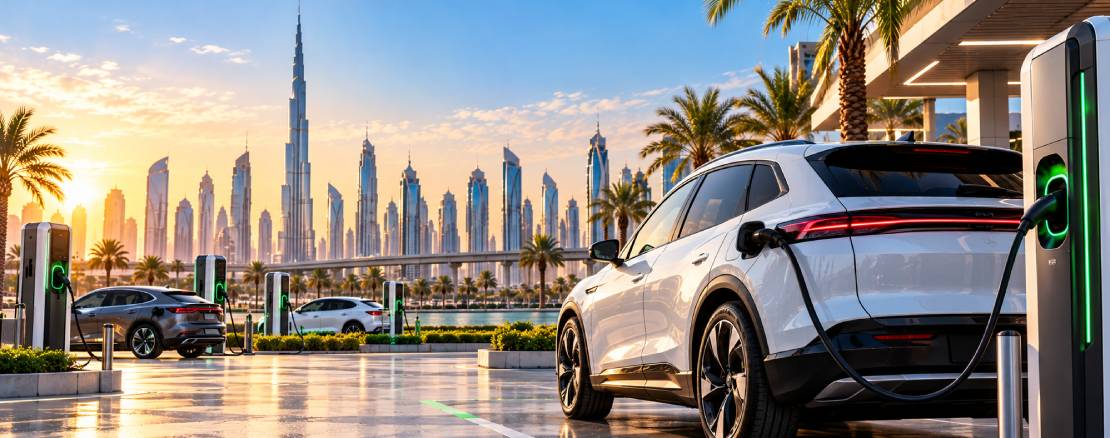

In 2015, Dubai had 435 registered green vehicles. By August 2026, it had 112,813.
We took these figures from the Supreme Council of Energy session at WETEX 2026, held at Dubai World Trade Centre from 20 to 22 October. The slides covered Dubai’s Green Mobility Strategy, its targets for 2030 and 2050, and a dashboard showing where things stand today.
One point stood out. The number of EVs and hybrids is growing much faster than public charging is planned to grow. So, most charging will have to happen privately, at villas, offices, hotels and fleet depots.
If you’re thinking about an EV charger in Dubai, either a villa EV charger in Dubai or chargers for your staff car park, this is what the numbers mean for you.
Dubai’s EV Numbers in 2026 (WETEX Data)
Dubai’s green vehicle count has more than doubled in three years. It went from 47,707 in 2023 to 112,813 by August 2026.
Registered Green Vehicles by Year
Dubai added 26,468 green vehicles between 2024 and 2025 alone. By August 2026, it had added another 16,925, with several months of the year still left.
EVs and Hybrids: How the Split Has Changed
“Green vehicles” covers fully electric cars and hybrids. The mix between them has changed over time.
Hybrids made up 82% of green vehicles in 2019. EVs took the lead in 2023 and 2024, at 54%. In 2026, the split is about 46% EV (roughly 51,900 cars) and 54% hybrid.
So EVs’ share has slipped a little over the last two years, but their actual number keeps rising every year. Each of those EVs, and every plug-in hybrid, needs somewhere to charge regularly. That everyday need is what sits behind every enquiry about an EV charger in Dubai.
It’s easy to miss one detail on the dashboard. The government owns only 2% of Dubai’s EVs and 10% of its hybrids. Private owners and companies own the rest, and they mostly charge at home or at work.
Still Only 4.5% of the Road
Green vehicles are 4.5% of all vehicles in Dubai. Working back from that, the total fleet is about 2.5 million vehicles (our estimate).
That means that after ten years of growth, about 95 in every 100 cars still run on petrol or diesel. For anyone planning a commercial EV charger in Dubai, that tells you the market is still early and has plenty of room to grow.
Dubai Green Mobility Strategy Targets for 2030 and 2050
The Green Mobility Strategy sets clear targets. These are the ones shown at WETEX 2026.
By 2030
- 10% of all registered vehicles in Dubai to be green (4.5% today)
- 58% of government vehicles to be hybrid or EV
- 2,500 public charging stations
- 104 million litres of fuel saved through green mobility
By 2050
- 100% of registered vehicles to be green
- 100% of government vehicles to be hybrid or EV
- 165,000 public charging stations
- 1,757 million litres of fuel saved
Where the DSM Strategy 2050 Fits In
The Green Mobility Strategy is part of a larger plan, the Dubai Demand Side Management (DSM) Strategy 2050, which was updated in 2024. It aims for 30% savings in electricity and water by 2030, and at least 50% by 2050. For fuel, the 2030 target is a 12% saving, which works out to 224 million liters.
Programme 11: Efficient Mobility and Smart Charging
The DSM Strategy is built on 12 programmes. Programme 11 is Efficient Mobility and Smart Charging.
The word “smart” is doing real work there. Dubai wants far more EVs on the road while also cutting how much electricity the city uses. Those two goals only fit together if chargers can schedule charging, share power between cars and report how much they use.
That applies to a single villa EV charger in Dubai just as much as to an office car park full of charging bays.
The Charging Gap: Why Public Chargers Alone Won’t Be Enough
The short version: Dubai’s targets add green cars much faster than they add public chargers.
The 2030 Math’s
If 10% of a 2.5-million-vehicle fleet is green by 2030, that’s about 250,000 green vehicles. Divide them across 2,500 public charging stations and you get roughly 100 vehicles per station.
Not every green vehicle needs to plug in, because standard hybrids charge themselves as they drive. But even if only half of those 250,000 vehicles are EVs, that’s still about 50 cars per public station. And the sum assumes Dubai’s total fleet stays the same size, which is unlikely.
The charging gap at a glance Green vehicles today: 112,813 (4.5% of all vehicles) |
Where Most Charging Will Actually Happen
Public stations will mainly serve people out on the road: quick top-ups, taxis, visitors, and drivers with no parking of their own. The daily charging that keeps an EV going will happen wherever the car is parked for hours.
That’s usually one of two places. At home overnight or at work during the day while the car would be parked anyway.
The strategy points the same way. Its 2025 milestones include making private charging networks more visible and more available, as well as public ones. For homeowners, that makes home EV charger installation in Dubai the most practical way to charge every day. For companies, an EV charging station for business in the UAE is turning from a nice extra into something people simply expect.
Home EV Charger Installation in Dubai: Why Villa Owners Are Moving Now
Villa owners are in the best position for home charging. You have your own parking and your own electricity supply, and the car sits unused all night.
What You Get from Charging at Home
Convenience
You plug in when you get home and leave in the morning with a full battery. You don’t have to plan your day around finding a charger.
Lower Running Costs
Charging on your own DEWA supply replaces your petrol spend and means you don’t have to rely on paid public fast charging.
No Queues
If public stations end up shared by about 100 vehicles each, waiting will be part of public charging. At home, nobody else is using your charger.
Appeal to Buyers and Tenants
A charging point that’s ready to use is one less job for a buyer or tenant who drives an EV, and that gives your villa an advantage when it’s listed.
What Installation Involves in Dubai
A villa charger isn’t a plug-and-play purchase. A licensed installer first checks whether your main distribution board can take the extra load. They then prepare the charger datasheet and electrical drawings and submit them to DEWA. The charger can only be switched on once DEWA has approved it.
Apartment residents also need a No Objection Certificate (NOC) from building management or the owners’ association before any work starts.
How Evolve Handles It
Evolves home EV charger installation in Dubai has four stages. We start with a site assessment of your supply, parking layout and cable route. Then we help you pick a charger that suits your car and your home. Next comes installation and testing. After that, we stay on hand for support and maintenance.
See how our home EV charger service works
EV Charging for Businesses: Offices, Malls, Hotels and Fleets
What the 2026 Milestones Signal
The Green Mobility Strategy’s 2026 milestones include two things: incentives for green vehicles and mandatory charging stations in government offices.
For now, that mandate only covers government buildings. But once government offices have chargers, employees, visitors and tenants start to expect them at private offices, malls and hotels too. Regulation may follow, but expectations tend to change first.
Government Fleets Are Running Ahead of Their Own Targets
Under DSCE Directive 02/2020, government entities have targets for buying hybrids and EVs: 10% of purchases from 2020 to 2024, 20% from 2025 to 2029, and 30% from 2030.
By 2026, green vehicles were already 23.9% of the government fleet, and the 2030 goal is 58%. Every one of those vehicles charges at a government site, and private fleet operators can expect the same pressure to build.
Taxis and Buses Will Need Depot Charging
The RTA plans to switch its public transport fleet to electric and hydrogen by 2050:
Fleet | 2030 | 2035 | Full conversion |
Taxis | 30% | 50% | 100% by 2040 |
Buses | 10% | 20% | 100% by 2050 |
School buses | 10% | 30% | 100% by 2050 |
Converted fleets charge at depots, overnight or between shifts. That will make depot charging a large share of demand for any commercial EV charger in Dubai in the coming years.
What Evolve Offers Businesses
- Design and consulting: how many chargers you need, where they should go, and what your electrical supply can handle
- Installation: fitting, cabling and testing across your site
- Revenue and management software: bill users, track usage and control who can charge
- Financing or leasing: spread the cost instead of paying it all upfront
Explore our EV charging solutions for business
What We Saw at WETEX 2026
We also spent time on the show floor, and two trends were easy to see.
Chargers That Show Whether They’re Free
Several DC chargers on display had large screens showing a live map of charger availability, with the prompt “Check charger availability before you go.” This ties directly to the strategy’s 2025 milestone on making private charging networks more visible. For a business installing an EV charging station for business in the UAE, networked chargers that report their status will soon be standard.
Robotic Charging Arms
One of the more striking demos was a robotic arm that plugs the connector into the car by itself. It’s still early, but it shows where fleet and depot charging is heading: less hands-on work and more automation run by software. For anyone weighing up a commercial EV charger in Dubai for a fleet, it’s worth choosing hardware and software that can be upgraded later.
How to Choose the Right EV Charger in Dubai?
The right EV charger in Dubai depends on where it’s going, what you drive and who will use it.
AC or DC?
AC chargers are what most homes and offices use. The car’s own onboard charger converts the power, so a full charge takes a few hours.
DC chargers do the conversion themselves and send power straight to the battery, which is much faster. They also need a much bigger electrical supply and a bigger budget, so they suit fleets, malls and public sites.
Charger Options Compared
Charger | Power supply | Best for | Good to know |
7kW AC | Single-phase | Villas, overnight charging | Adds about 7 kWh per hour, which covers most daily driving |
11kW AC | Three-phase | Villas and offices | Check that your car accepts 11 kW on AC. |
22kW AC | Three-phase | Hotels, malls, and offices with short stays | Many cars only accept 7 kW or 11 kW on AC, so 22kW won’t always charge faster. |
DC fast | High-capacity supply | Fleet depots, taxis, public sites | Fastest option, but needs a much bigger supply and budget |
Smart Features Worth Having
Look for scheduling, so you can set when the car charges. Load management matters too, because it shares power with the rest of the house or building and stops the main board from overloading. Businesses should also look for access control, billing and usage reports. These are the features Programme 11 of the DSM Strategy is pushing for.
Why Maintenance Matters in UAE Heat
Dubai’s heat, dust and sun are hard on outdoor equipment. Chargers can cut their output when they get too hot, and cables and connectors wear faster in direct sunlight. Choose a charger rated for high temperatures and dust, install it in the shade where you can, and book regular checks.
Browse our EV chargers or see our installation and maintenance services to find the right fit for your villa EV charger in Dubai or business site.
The Gap Is Real, and It Starts Where You Park
The WETEX data all point the same way. Green vehicles in Dubai went from 435 to 112,813 in just over a decade. The 2030 targets work out to about 100 vehicles per public charging station.
Public chargers will help, but most cars will charge wherever they’re parked. Whether you need a villa EV charger in Dubai or an EV charging station for business in the UAE, planning now means your DEWA approval, any electrical upgrades and the installation are done before demand peaks.
Get a free consultation with Evolve on WhatsApp and find the right EV charger in Dubai for your home or business.
FAQs
As of August 2026, Dubai had 112,813 registered green vehicles (EVs and hybrids together). About 46% of them are fully electric, which is roughly 51,900 EVs, based on Supreme Council of Energy data shared at WETEX 2026.
Dubai wants 10% of all registered vehicles to be green by 2030, up from 4.5% today. It also wants 58% of government vehicles to be hybrid or EV and 2,500 public charging stations.
The Green Mobility Strategy targets 2,500 public charging stations by 2030 and 165,000 by 2050.
Yes. A licensed installer assesses your electrical supply, prepares the drawings and submits them to DEWA. The charger can be switched on once DEWA approves it. Evolve handles home EV charger installation in Dubai from the site assessment through to support.
The 2026 mandate shown at WETEX covers government offices. For private businesses, the push currently comes from employees, customers and fleet targets rather than a rule. Check the current requirements for your building with your installer before planning a commercial EV charger in Dubai.