
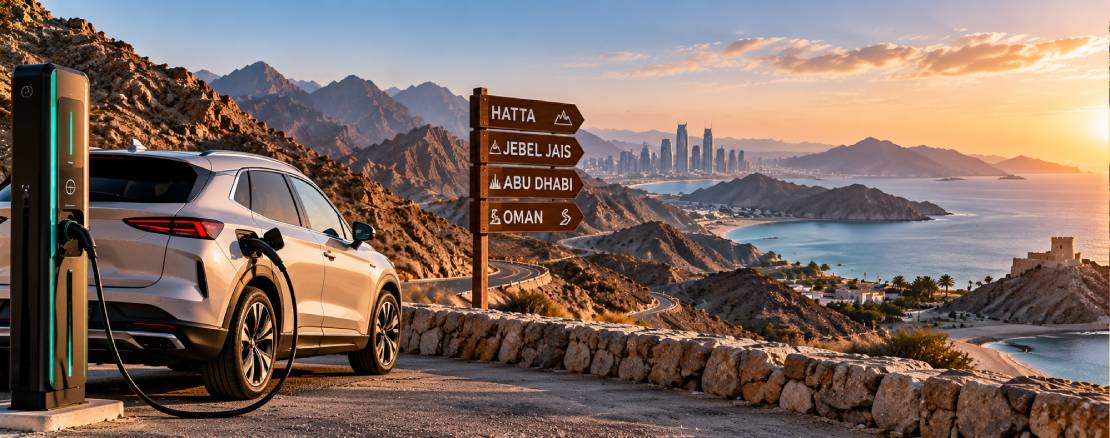

Winter is when UAE EV owners get to use their cars for long, quiet, cheap drives. A good EV road trip UAE plan needs three things: knowing your real range, knowing where the fast chargers are, and leaving home full. That last one is why a dependable villa EV charger Dubai drivers can plug into overnight matters more than any app.
Why winter is peak road-trip season for UAE EV owners
The calendar does half the work. For schools on the unified calendar, the October half-term runs from 12 to 16 October 2026, which means nine days away from school once both weekends are counted. National Day follows on 2 and 3 December, and the winter break runs from 14 December 2026 to 3 January 2027.
The weather does the rest. The official WLTP range is tested at 23°C with climate control off. That is close to a UAE winter afternoon, so your EV range UAE road trip numbers in December sit much nearer the brochure figure than in August.
The catch is that everyone travels on the same weekends, and that is when highway chargers’ queue. An EV Road trip UAE families enjoy starts with a plan made before the car leaves the driveway.
Real-world range: highways, mountain climbs and AC use in cooler weather
Three things decide your EV range UAE road trip figure.
- Speed: At a sustained 120 km/h, most EVs deliver about 75 to 82% of their WLTP range. One European test found a car rated at 450 km manages roughly 330 km at a steady 110 km/h. A safe rule is to plan on 70% of the rated range for highway driving and keep 15% in reserve.
- Climbs: The Jebel Jais viewing deck sits around 1,300 metres above sea level. Lifting a two-tonne car that high takes roughly 7 kWh on top of normal driving. You get a good share back on the way down. On a 2019 EV road trip, a Chevrolet Bolt recovered as much as 94 km of range through regenerative braking on the Jebel Jais descent. In that sense, part of your Jebel Jais EV charging is done by the mountain itself.
- Climate control: Mild days need little cooling, so the AC barely dents the range. Mountain evenings are different. Jebel Jais is typically around 10 degrees cooler than the UAE average. If you will need the heater, warm the cabin while the car is still plugged in at home.
Charging along popular routes: Hatta, Jebel Jais, Abu Dhabi, Al Ain and Oman
Distances below are approximate round trips from central Dubai.
Route | Round trip | Where to charge | Plan |
Hatta | About 270 km | DEWA fast charger at ENOC Hatta, AC points in town | One charge for most EVs. Top up over lunch for comfort. |
Jebel Jais | About 350 km | Public chargers in RAK city, two reported on the mountain | Long-range EVs can do it. Others top up in RAK. |
Abu Dhabi | About 280 km | ADNOC megahub on the E11, Charge AD in the city | The easiest route in the country. |
Al Ain | About 280 km | Charge AD network | One charge for most EVs. |
Muscat via Hatta | About 900 km | Hatta, Sohar, Muscat | DC stops each way. Plan everyone. |
Hatta: EV charging Hatta is better than most people expect. DEWA installed a fast-charging station at the ENOC petrol station in Hatta. Its network also lists the Hatta Customer Happiness Centre, the DEWA Mosque and Hatta Public Library.
Jebel Jais: The drive is around 170 to 180 km each way and takes about two hours. Ras Al Khaimah has more than a dozen public charging stations. RAK’s tourism authority also announced two stations on the mountain, at the Viewing Deck Park and the Jais Adventure Centre. Treat Jebel Jais EV charging on the mountain as a bonus, and check the live status first.
Abu Dhabi and Al Ain: ADNOC’s EV Megahub at Saih Shuaib on the E11 has 60 high-speed chargers, and most EVs go from 0 to 80% in about 20 minutes. Abu Dhabi’s Charge AD network is rolling out 1,000 chargers at 400 locations across Abu Dhabi Island, Al Ain and Al Dhafra.
Oman: A Dubai to Oman EV trip is the one that needs real planning. Muscat is roughly 450 km from Dubai via Hatta and the Al Wajajah border. Oman had about 160 charging stations in 2025, concentrated around Muscat, Sohar, North Al Batinah and Salalah. Before you go, confirm that your insurance covers Oman, and check the border status and current travel advice.
Planning apps and networks: DEWA, UAEV, ADNOC and others
No single public charging stations UAE map shows every charger with live status. Use the network’s own app for availability and a crowd-sourced map for recent driver check-ins.
- DEWA EV Green Charger (Dubai): Dubai had 2,223 charging points by the end of the first quarter of 2026, including those of DEWA-licensed operators. You can find them on DEWA’s website, its app and 14 other digital platforms, and Guest Mode works without an account.
- UAEV (federal): The tariff is AED 1.20 per kWh for DC and AED 0.70 for AC, plus VAT, and the app shows live status and handles payment.
- ADNOC E2GO (highways): It has more than 400 chargers, with 15 highway hubs expected to be running by the end of 2026.
- Charge AD (Abu Dhabi, Al Ain): It uses the same AED 0.70 AC and AED 1.20 DC tariffs.
- PlugShare and Google Maps: These are useful for cross-checking and for Oman.
Set up accounts and payment cards at home. A forecourt with a weak signal is a poor place to start, and it can spoil an EV road trip UAE drivers planned well in every other way. Our guide to DC fast charging vs AC charging explains what to expect from each.
Leave home at 100%: why a reliable home charger matters most
Every route in the table gets easier if you start full, and home is the cheapest place to do that.
DEWA’s residential slab tariff runs from 23 to 38 fils per kWh, plus a 6-fils fuel surcharge and 5% VAT. That works out to roughly AED 0.30 to 0.46 per kWh. Adding 60 kWh costs about AED 18 to 28 at home and about AED 76 on a public DC charger.
Speed matters too. A 7-kW wall charger adds 60 kWh in about eight hours, and an 11-kW unit takes under six. A basic three-pin cable can take more than a day.
A properly installed villa EV charger Dubai homeowners can schedule lets you set charging to finish just before departure. Stay at 80% for daily driving and go to 100% for the trip. That is how you get your full EV range UAE road trip figure without the battery sitting full for days.
For more detail, read DEWA Green Charger vs home chargers and our guide to smart charger scheduling and load balancing.
Charging etiquette and backup plans
Holiday weekends test everyone’s patience. A few habits help:
- Unplug at 80% on DC chargers. Charging slows sharply after that, and others are waiting.
- Move the car when you finish. Some networks charge idle fees.
- Never Park in a charging bay unless you are charging.
- Check in on the app. It keeps every public charging station UAE map accurate for the next driver.
Then build a plan B:
- Pick two chargers for every stop. If the ENOC fast charger is busy, the AC points in town are your backup for EV charging Hatta.
- Arrive with 15 to 20% left.
- Screenshot charger locations before mountain roads, where signal drops.
- Carry your Type 2 cable. Our list of essential EV charging accessories covers the rest.
How Evolve helps owners start every trip fully charged
Evolve installs home charging across Dubai and the UAE. The process covers a site assessment, a charger recommendation, professional installation, smart set-up, load management guidance, testing and handover, and ongoing maintenance.
For villas, Evolve recommends a smart wall-mounted AC charger with up to 22 kW on three-phase power, Type 2 compatibility, built-in energy monitoring and load balancing. It is built for garages, carports and outdoor driveways.
If you are comparing options, start with our villa EV charger Dubai installation service and the 2026 homeowner’s guide to EV charger installation. A villa EV charger Dubai families can trust turns every EV road trip UAE weekend into a simple routine: plug in the night before and leave full.
Book a free consultation before the December rush.
FAQs
Yes, if your EV has a WLTP range of about 500 km or more and you leave at 100%. The round trip is roughly 350 km, plus the climb. With a shorter-range car, top up in Ras Al Khaimah city. Do not rely on Jebel Jais EV charging at the top without checking live status.
Yes. A Dubai to Oman EV route via Hatta has DEWA chargers before the border. In Oman, OOMCO has installed 12 fast chargers along major highway routes. Shell Oman and Porsche plan more than 130 chargers by the end of 2026. Coverage is thinner than in the UAE, so plan every stop.
Yes. Charge to 100% and time it to finish shortly before you leave. Go back to 80% for daily driving. A scheduled villa EV charger Dubai setup does this automatically.