
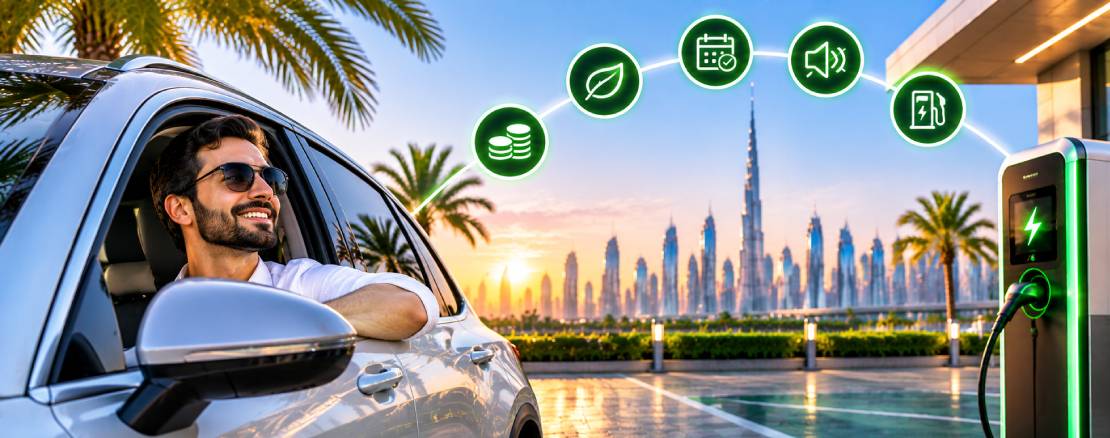

When people think about buying an electric car, they usually focus on the big questions: range, price and charging. That makes sense. But talk to anyone in Dubai who has driven electric for a year, and they’ll mostly mention the small, everyday chores that slowly dropped out of their week.
That’s what this guide covers. These are the practical benefits of electric cars you notice in your first month, and each one is based on UAE prices and rules as of November 2026.
You also won’t be the only one on your street. By the end of 2025, Dubai had 47,944 EVs, up from 37,486 a year earlier, an increase of 27.9%. The EV advantages UAE drivers talk about have now been tested by tens of thousands of people.
1. Weekly Trips to the Petrol Station
Think about how often fuel shapes your day. The warning light comes on during the school run. You pull into a busy forecourt in 40°C heat, wait your turn, fill up, pay, and join the traffic again.
With a home charger, that routine goes away. You plug in when you get home, the car charges overnight, and it’s ready when you leave in the morning. For most owners, that means no more petrol stations for everyday driving. Ask EV owners what they like most about the switch, and this is usually the first thing they mention.
How Home Charging Fits into Your Day
You don’t stand next to the car or wait for anything. Home charging stations work with any passenger EV and come in power outputs from 3.7 kW to 22 kW, so the setup can match your car and how much you drive. You can see how this works for villas and apartments on Evolve’s home charging solutions page.
What About Longer Drives?
For weekends away, the public network is your backup, and it’s growing quickly. DEWA’s Green Charger network now has 23,600 registered users and 2,223 charging stations across the city. If you’re planning a trip to Hatta or Jebel Jais, Evolve’s winter road trip charging guide explains where to stop.
2. Waiting to Find Out What Fuel Will Cost Next Month
The UAE revises retail fuel prices at the end of every month to align them with global prices. In 2026, that has meant some big swings. In October, Super 98, Special 95 and E-Plus 91 roses by Dh0.60 a litre, or 16%, reaching a more than four-year high. November brought Super 98 back down to Dh4.16 and Special 95 to Dh4.04. For comparison, Super 98 cost Dh3.66 a litre in May.
For a family SUV, those changes add up. A 74-litre SUV tank of Super 98 costs about Dh308 in November, down from about Dh326 in October.
Electricity works differently. At home in Dubai, you pay roughly AED 0.23 to AED 0.38 per kWh, because DEWA’s residential tariff is slab-based. For public charging, DEWA charges AED 0.735 per kWh for AC and AED 1.26 per kWh for DC, VAT included.
What 1,000 km Costs in Dubai (November 2026)
How you fuel the car | Energy needed | Price used | Approx. cost per 1,000 km |
Petrol car (Special 95) | 90 litres | Dh4.04 per litre | Dh364 |
EV on public DC fast charging | 200 kWh | Dh1.26 per kWh | Dh252 |
EV on public AC charging | 200 kWh | Dh0.735 per kWh | Dh147 |
EV charged at home | 200 kWh | Dh0.23 to Dh0.38 per kWh | Dh46 to Dh76 |
The table shows where the real savings come from. Public fast charging costs less than petrol, but charging at home is what turns the benefits of electric cars into a noticeably smaller monthly bill. Of all the EV advantages UAE residents get, predictable running costs are among the easiest to measure. If you want to know what setting up home charging involves, Evolve’s 2026 homeowner installation guide covers costs and steps.
3. Oil Changes and Long Service Checklists
A petrol engine has hundreds of moving parts, and many of them need fluids, filters and regular replacing. An electric motor has far fewer. When you own a no oil change electric car, a whole category of workshop visits simply stops.
What’s No Longer Under the Bonnet
Electric vehicles don’t have timing belts, oxygen sensors, fuel filters, spark plugs or multi-speed transmissions, and they don’t use engine oil either. In practical terms, you can cross these off your list:
- Engine oil and oil filter changes
- Spark plug replacements
- Timing belt replacements
- Fuel filter changes
- Gearbox servicing on multi-speed transmissions
Your Brakes Last Longer Too
When you lift off the accelerator in an EV, the motor slows the car down and sends some of that energy back to the battery. This is called regenerative braking. Because of it, the brake discs and pads wear out more slowly than on a petrol or diesel car, so they usually last longer and need less maintenance.
What This Means for Running Costs
This is why EV low maintenance is backed by real numbers. A US Department of Energy report found that petrol cars cost around 10 cents per mile to maintain on average, while electric cars cost around 6 cents. That’s roughly 40% less.
How you charge also affects how long the battery stays healthy. Slow overnight charging is generally better for EV batteries than frequent fast charging, which is one more reason to charge at home. Evolve’s guide on choosing the right home EV charger in the UAE explains what to look for.
4. Paying for Parking in Busy Areas (and for a Salik Tag)
Parking got more expensive this year. From June 1, 2026, Parkin added 5% VAT to all its parking services. In many zones, the standard Dh4 hourly rate went up to Dh4.20.
The Green Parking Benefits Dubai Offers EV Drivers
This is where the green parking benefits Dubai offers become useful.
Where to Find Green Bays
The RTA has set aside parking spaces for electric vehicles only in different parts of Dubai. They’re painted green and have signs showing they’re reserved for EVs. Many malls, offices and government centres also have designated EV spots.
The Rules to Know
You can use these spaces for up to four hours. Stay longer and you’ll be fined Dh100. Petrol cars parked in these bays face a Dh1,000 fine. One thing to be clear on: the free parking applies to these green bays, not to every paid space in the city. Always check the sign.
Salik and EVs: What You Actually Get
A lot of people believe electric cars are exempt from tolls. They aren’t. EV owners get a free Salik tag, but trips through Salik gates are still charged. EVs are not exempt from Salik tolls.
So with Salik and EV ownership, you save on the tag, but you still need to plan around the toll rates like every other driver. Peak hours (6 am to 10 am and 4 pm to 8 pm) cost Dh6.30, low-peak hours (10 am to 4 pm and 8 pm to 1 am) cost Dh4.20, and crossings between 1 am and 6 am are free.
5. Sitting in a Hot Car with the Engine Running
Anyone who has spent a summer in the UAE knows this one. You’re waiting outside a school or a mall, and the only way to stay cool in a petrol car is to keep the engine running. That burns fuel and puts out exhaust fumes, and it’s noisy.
In an electric car, the air conditioning runs off the battery, so there’s no engine idling and no exhaust. Many models also let you cool the cabin from your phone before you get in. On a lot of these cars, if you pre-cool while plugged in at home, the energy comes from the charger instead of the battery. It’s one of the EV advantages UAE drivers appreciate most from May to September.
A smart home charger makes this easier. Smart EV chargers let you schedule charging around your routine, so the car is charged and cool when you need it. You can see how this works on Evolve’s villa EV charger page. A cooler, quieter cabin with no fumes is one of the benefits of electric cars that’s hard to go back from.
Good to Know: What Still Needs Your Attention EV low maintenance still means some maintenance. Keep these on your list: ● Tyres: EVs are heavier and deliver more torque, so tyres can wear faster. ● Brakes: Brake fluid breaks down over time, and pads and discs will eventually wear out. ● Heat-related checks: In the UAE’s hot climate, regular servicing helps protect your EV’s battery and performance. ● Salik tolls: You get the tag free, but every crossing is still charged. ● Approvals: Apartments often need more approval steps than people expect. |
The Charger at Home Makes All of This Possible: Why Dubai Drivers Choose Evolve
Every benefit above depends on one thing: a reliable charger where your car sits overnight. Without one, you just swap petrol stations for public charging queues. With one, you get no more petrol stations, lower bills and a full battery every morning.
One Dubai Team from Start to Finish
Evolve is a local company. It operates as SMF Electric LLC from Al Quoz Industrial Area 2 in Dubai and installs chargers across the UAE. Evolve manages home charger projects from start to finish: site assessment, choosing the equipment, compliant installation, testing and ongoing support. That covers villas, townhouses, apartments and commercial sites.
A Charger That Suits Your Car and Your Home
Many Dubai households have two different car brands. The latest Tesla Wall Connector uses the standard Type 2 connector, so it can charge brands like Mercedes, BMW, Audi and Porsche. One Wall Connector can serve both cars without adapters. More details are in Evolve’s Tesla charging guide.
Support After Installation
Evolve’s maintenance service includes remote monitoring, repairs and upgrades to keep your charger working. Financing and leasing options are also available. For offices, hotels and residential buildings, every business installation includes an annual maintenance contract (AMC). You can learn more on the business charging solutions page.
If you’re thinking about making the switch, the simplest first step is a site survey. Contact Evolve to book one and find out what your home needs.
FAQs
The biggest ones are lower running costs from home charging, fewer servicing visits, free parking in green bays across Dubai, a free Salik tag, and air conditioning that runs without an idling engine.
No. Electric motors don’t use engine oil, so oil and oil filter changes aren’t needed. You’ll still need tyre, brake and cooling system checks.
No. The Salik tag is free for EV owners, but they’re still charged every time they pass through a Salik gate.
Yes, in green EV bays, for up to four hours. Normal paid parking rates apply everywhere else.
Home charging costs roughly AED 0.23 to AED 0.38 per kWh, depending on your DEWA tariff slab. For an average EV, that comes to about Dh46 to Dh76 per 1,000 km.